Welcome to Memorandum Deep Dives. In this series, we go beyond the headlines to examine the decisions shaping our digital future. 🗞️
This week, we examine the price gap between American and Chinese artificial intelligence systems, with open-source Chinese options now running 60% to 90% cheaper than the leading American ones.
The obvious reading is a price war, with Chinese labs buying market share cheaply and raising prices once customers are locked in, but the economics point somewhere else. Abundant electricity and a State Council directive targeting 70% adoption of AI agents and intelligent devices by 2027 mean these labs are judged on how widely their models spread, so profit at the model layer was never the point. American companies have followed the arithmetic, and on the largest model marketplace the share of work they route to Chinese systems has peaked at 46% this year.
What that split hands buyers is unusual, because a company can send its hardest problems to the most capable system and everything routine to the cheapest one that works. That freedom lasts only while both sides are still competing for users, and both have already begun hedging: Washington has threatened sanctions against Chinese models, while Beijing has spent the past month asking its own labs to limit overseas access to their best systems. The luxury on offer today is not the best model or the cheapest one, but the ability to use both.
Sponsored by

The Hidden Cost of Slow SaaS Billing
Slow billing doesn't just create friction — it delays cash and compounds across every deal you close.Slow billing doesn't just create friction — it delays cash and compounds across every deal you close.
Most SaaS finance teams assume the gap between contract signature and first invoice is a minor inconvenience. The Tabs Billing Lag Calculator puts a dollar figure on it.
Answer 5 quick questions about your contracts, invoicing process, error rate, and DSO, and the calculator benchmarks your billing lag against top SaaS companies — then shows you exactly what it's costing you.
Two minutes. One number that's hard to ignore.
Goodies delivered straight into your inbox.
The Ferrari & the Volkswagen: two visions for the future of AI
Every industry eventually splits into two camps. One builds for as many people as possible and competes on price, while the other builds the best thing it can and charges what that costs. Neither camp is making the smarter choice, because each is answering a different question about what a company is for.
The car industry shows the split more plainly than most. Ferrari built its name engineering some of the fastest and most desirable cars ever made, sold in small numbers at very high prices, while Volkswagen built its name on dependable cars for ordinary households, sold in enormous numbers at prices most people could reach. Ferrari could build a family hatchback if it wanted to, and Volkswagen could build a supercar, but each company instead decided what kind of value it wanted to create and then organized its factories, its engineers, and its pricing around that decision.
The same split now runs through artificial intelligence, except that the two camps this time are countries rather than companies. The world's two largest economies have reached different answers about what the technology is supposed to be, and the distance between those answers keeps widening.
On one side, America is building the Ferrari, with its leading laboratories pouring extraordinary sums of money and computing power into the most capable systems anyone has built. They charge prices that reflect what that costs, and the revenue funds the next system. China is building the Volkswagen, producing systems that come close enough to the best and pricing them so far below the leaders that quality stops being the deciding factor. In many cases he software is handed over at no cost, for anyone to download and run on their own machines.
Neither country picked its side purely out of conviction, because in both cases what was available shaped the choice. Ferrari builds what it builds partly because it can reach the engineers and the customers who make it possible, and Volkswagen builds what it builds partly because its factories were designed to reward volume rather than exclusivity.
Being denied the fastest engine
For China, that constraint has a date, because since 2022 Washington has restricted the sale of the most advanced computer chips to Chinese buyers. Those chips are the equipment used to build AI systems in the first place, so without reliable access to them, matching America on raw capability was never a realistic goal. Chinese engineers optimized for a different measure instead: the cost of producing each answer. They built systems that handle most of the same work while using far less computing power per question, which made them cheap to run rather than impressive to demonstrate.
The gap this produced is easier to feel than to describe, and the clearest way to see it is in what buyers are charged. Open-source Chinese systems now run between 60% and 90% cheaper than the leading American ones, according to OpenRouter, which routes the traffic. On a single request a difference like that is invisible, but companies do not make single requests. A software firm running its engineers' code through an AI assistant makes that same purchase millions of times a month, and at that volume the discount stops being a discount and becomes the difference between a product that is affordable to build and one that is not.
Where the cheap price comes from
Chinese systems are not cheap out of generosity, and the first of two structural advantages behind that price is electricity.
Every question put to an AI system is answered inside a data center, by computers that draw power on an industrial scale, and a large facility can consume as much electricity as a small city. That cost sits among the highest ongoing expenses in the business, and unlike almost everything else in software, it cannot be engineered away, so somebody has to pay it every month. China already generates more than twice as much electricity as the United States, and is expected to add more than six times as much new capacity over the next five years, while American firms are delaying data center projects because local power grids cannot carry them. A Chinese company can charge very little because the cost of power is low, and an American company matching that price would lose money on every request.
Hire smarter with Athyna, save up to 70% on salary costs.
Athyna connects you with top LATAM AI talent, fast!
*This is sponsored content
A government that counts use, not profit
The second advantage is that nobody in Beijing is waiting for these companies to turn a profit, and an official directive published in August 2025 explains why. It instructs the country to push AI into six priority areas, from industrial development to public services and governance, and sets a target for new-generation intelligent terminals and AI agents to pass 70% adoption by 2027 and 90% by 2030. Nowhere does it say who is supposed to earn money, which makes it incoherent as a business plan and perfectly coherent as industrial policy.
The government is not trying to grow AI companies but to make its factories, hospitals, and bureaucracies run better, and the payoff arrives as national economic growth rather than corporate profit. That arrangement lets the AI companies sell below cost more or less indefinitely, because they are the delivery mechanism rather than the destination. China has run this playbook before in solar panels and electric vehicles, winning global market share while leaving its own producers struggling to make money, and the wager each time is that what is lost at the product layer returns many times over across the wider economy.
The customers stopped caring where it came from
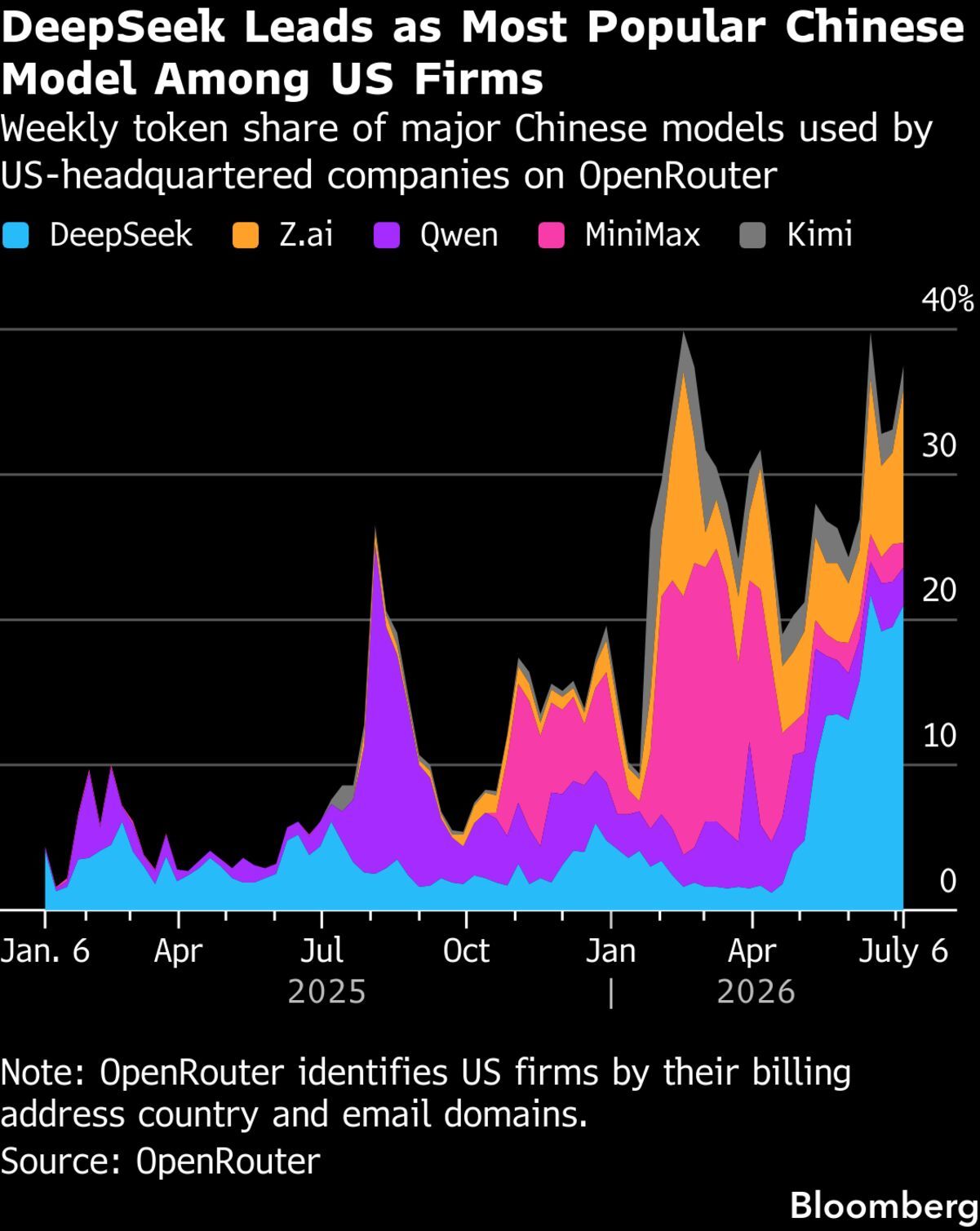
The strategy is working, and the clearest proof is that American companies have quietly started switching. Most firms now reach AI through routing services that let them change providers with a line of code, and on the largest of those services the share of work American companies send to Chinese systems climbed from 4.5% in the first half of 2025 to above 30% every week since February, peaking at 46%. The startup Lindy moved all of its work off Anthropic and onto China's DeepSeek, describing the decision as arithmetic rather than politics.
A household buys one car every few years and has to live with the choice, while a company buys intelligence thousands of times a day and can split the order however it likes. That difference is what makes this contest unlike the one Ferrari and Volkswagen are in, and it should worry the American laboratories, because the cheaper approach can quietly take the large, unglamorous middle where most of the world's computational work sits.
What the buyers are actually buying
What that switching actually buys is choice, and at the moment this is close to the best market a customer could be in. America is pursuing one vision of artificial intelligence and China another, which leaves users free to decide which system deserves which task. The most capable ones can take the hardest problems, while the cheapest ones can take the routine work. Companies are no longer choosing a side so much as assembling their own mix of intelligence.
What makes this moment unusual is that neither side has won, and it is the competition between them that keeps the market open. Ferrari and Volkswagen are unlikely to wake up one morning and swap places, because doing so would undermine the reputations they spent decades building. Countries work differently, because national strategy changes whenever economics, politics, or security demand it. The United States can decide that its most capable systems should stay at home, and China can decide that its most advanced models are too strategically important to give away. That second possibility matters more than it sounds, because a system you have already downloaded stays on your machines, while access running on somebody else's servers lasts exactly as long as the owner is willing to provide it.
That contradiction is the whole of the present moment, because today both countries are trying to acquire users and tomorrow they may decide to keep them. The market feels open because the battle for adoption is still underway, and markets look very different once winners emerge and strategic interests harden into policy.
When the dust settles, customers may find they are no longer choosing between the Ferrari and the Volkswagen, but between two competing ecosystems, each with its own ideology, pricing model, and political constraints. The uncomfortable possibility is that the greatest luxury available today is not access to the best model or the cheapest one, but the freedom to use both.
P.S. Want to collaborate?
Share today’s news with someone who would dig it. It really helps us to grow.
Let’s partner up. Looking for some ad inventory? Cool, we’ve got some.
Deeper integrations. If it’s some longer-form storytelling you are after, reply to this email, and we can get the ball rolling.
What did you think of today's memo? |
|







.svg)
.svg)