Welcome to Memorandum Deep Dives. In this series, we go beyond the headlines to examine the decisions shaping our digital future. 🗞️
This week, we look at Apple’s leadership transition: Tim Cook stepping aside as CEO in favor of John Ternus, a 25-year hardware engineering veteran, at a moment when the company’s competitors are collectively pouring nearly $700B into AI infrastructure.
The obvious reading is that Apple is retreating from the AI race, handing the reins to a hardware leader while rivals double down on cloud-scale intelligence. That reading misses the crucial point that Apple is not abandoning AI; it is redefining where AI should live, betting that the device in your pocket, not a distant data center, is the more durable platform for intelligence.
The real signal is about strategic divergence: Apple’s $12.72B in annual capex, compared with hundreds of billions spent by hyperscalers, reflects a fundamentally different theory of how AI creates value. That distinction is what makes this transition worth a closer look.
Sponsored by

How Jennifer Aniston’s LolaVie brand grew sales 40% with CTV ads
The DTC beauty category is crowded. To break through, Jennifer Aniston’s brand LolaVie, worked with Roku Ads Manager to easily set up, test, and optimize CTV ad creatives. The campaign helped drive a big lift in sales and customer growth, helping LolaVie break through in the crowded beauty category.
The engineer takes the chair
Over the past few years, much of the news from the tech industry has revolved around artificial intelligence: the models, the risks, the shortcomings, and how companies are positioning themselves for the AI age. During that time, while Big Tech giants like Google, Microsoft, and Meta have made sweeping changes to their strategic priorities, one company has struggled to keep pace. Now, as it undergoes a leadership transition, that company has something very different in mind from the rest of Big Tech.
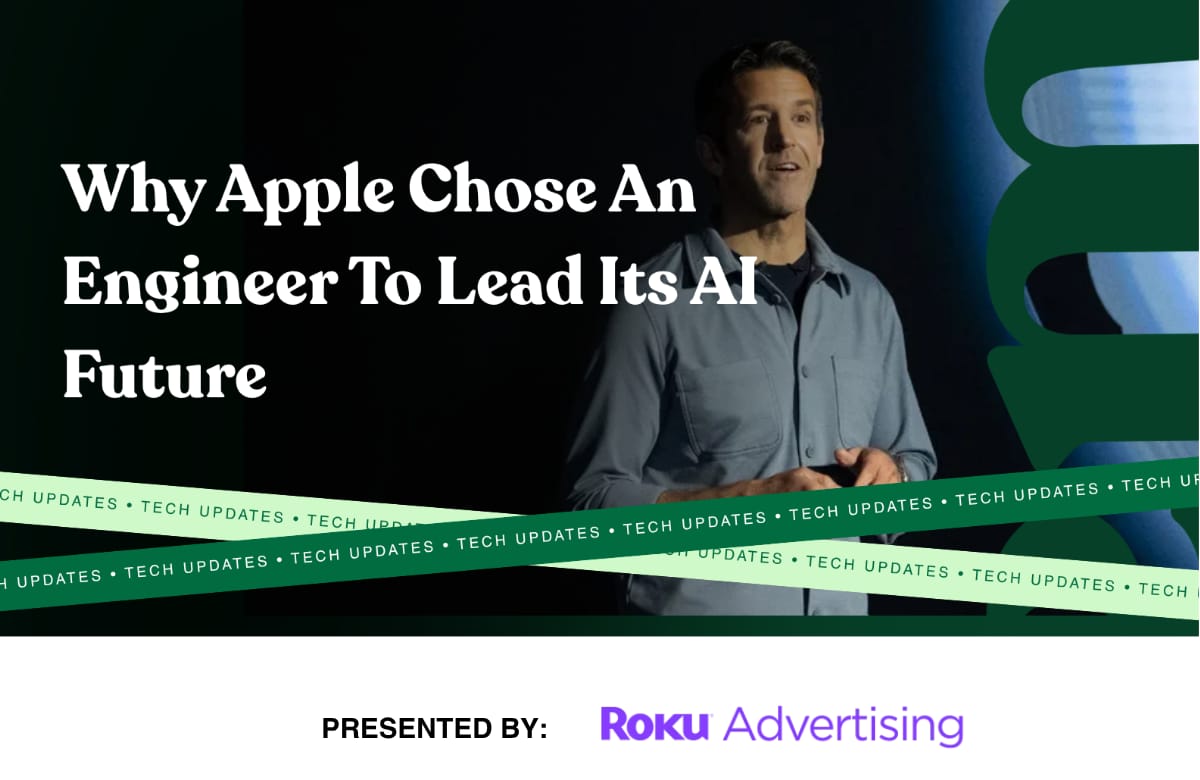
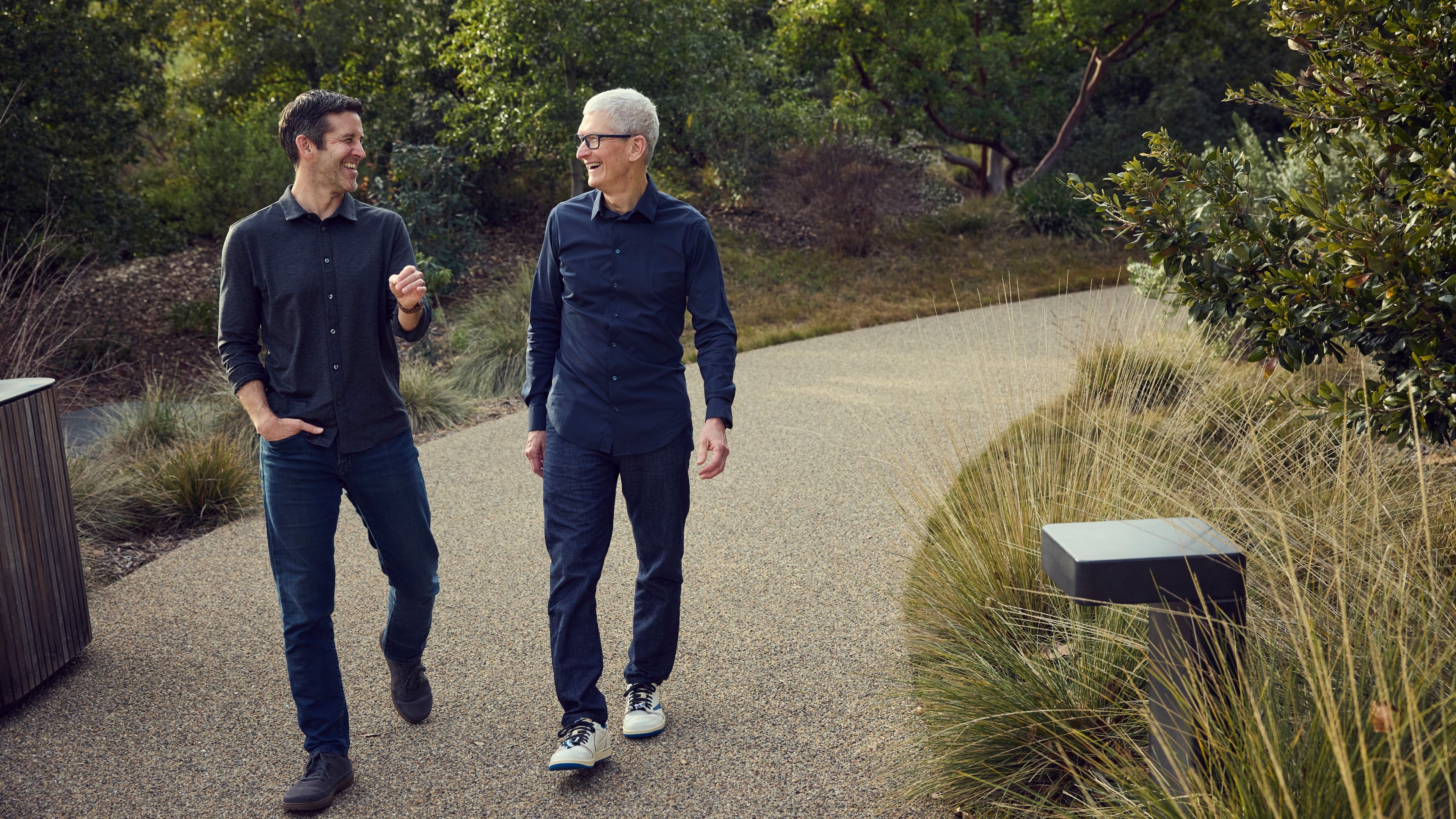
On April 20, 2026, Tim Cook announced that he would step aside as CEO and become executive chairman after spending 15 years turning Apple’s logistics operation into the envy of the industry. His successor, however, is a fundamentally different kind of leader.
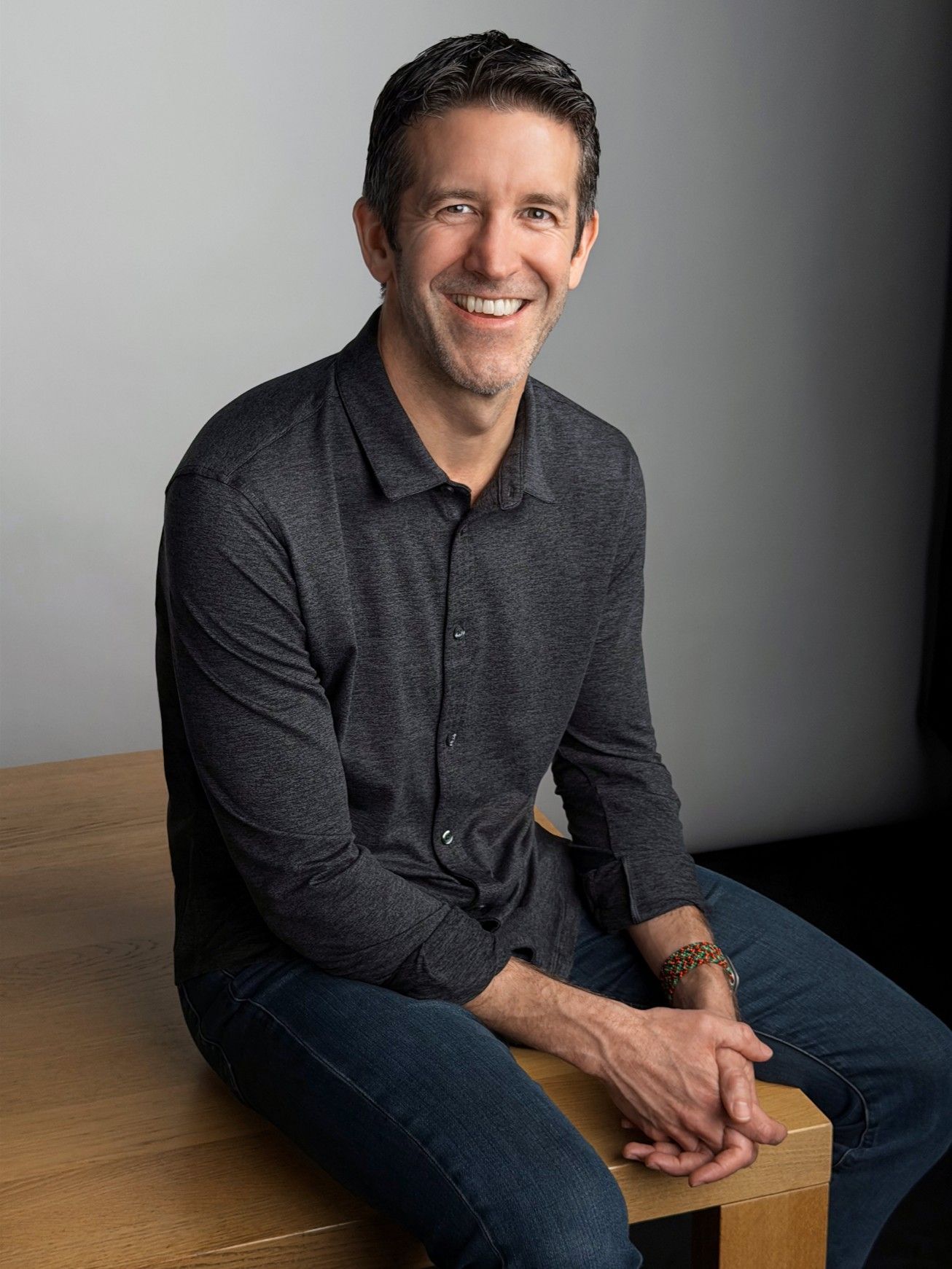
Stepping into the position of CEO from September 1 is John Ternus, who joined Apple in 2001 as part of the product design team working on a plastic desktop monitor called the Apple Cinema Display.
Over the past quarter century, he rose through the ranks of hardware engineering, overseeing every iPad model, AirPods, recent iPhones, and the Mac’s pivotal transition from Intel processors to Apple’s own silicon chips.
John’s elevation to CEO comes alongside another move that indicates where Apple sees its future. The company also elevated Johny Srouji, the architect of its custom chip strategy, to a newly created role of chief hardware officer, combining oversight of silicon design and physical hardware engineering under a single command for the first time.
The result, as Bloomberg reported, is a leadership structure in which the person who designs the chip reports to a CEO who spent his entire career designing the devices those chips power, and the signal that sends about Apple’s priorities is difficult to miss.
What the shift says about Apple’s AI thinking
To appreciate what Apple is doing here, it helps to understand what the rest of the industry has been doing, and how much Apple has not been doing it. In 2026, the four major hyperscalers, Amazon, Alphabet, Microsoft, and Meta, are projected to spend nearly $700B combined on capital expenditures. Of this, the vast majority is going into AI infrastructure: data centers packed with GPUs, networking equipment, and cooling systems designed to train and serve ever-larger language models.
Where competitors have poured money into building the biggest AI brains they can, Apple has instead spent the past decade wiring intelligence into the nervous system of its devices. At the same time, the company recognized it could not ignore cloud-scale AI altogether and, in January 2026, announced a multi-year collaboration with Google to build the next generation of Apple Foundation Models on Google’s Gemini technology, a deal reportedly worth about $1B per year.
During Apple’s Q1 2026 earnings call, Cook described the arrangement as a collaboration and stressed that the Gemini-powered system would still run on Apple devices and Private Cloud Compute (Apple’s privacy-focused server infrastructure built on its own silicon), maintaining the company’s data protection standards. In other words, Apple is willing to use someone else’s AI engine, but only if it can bolt that engine into its own chassis and control the experience from end to end.
The most visible casualty of this measured approach has been Siri. The conversational overhaul first previewed in 2024 was delayed past its initial 2025 target, and as of late April 2026, it has still not shipped. Google Cloud CEO Thomas Kurian confirmed at Google Cloud Next 2026 that a Gemini-powered, more personalized Siri would arrive before the year’s end. However, the specifics remain thin, and Apple’s WWDC in June is expected to offer the first real look at what iOS 27’s assistant can do.
Throughout 2025, the narrative that Apple was falling behind in AI became a fixture of tech and financial coverage, punctuated by Google’s market capitalization surpassing Apple’s for the first time since 2019 early in 2026, riding a wave of investor enthusiasm for Gemini. Against that backdrop, spending $1B a year to license another company’s AI can look less like strategic patience and more like a concession.
So why, at a moment of perceived AI weakness, would Apple hand the company to a hardware engineer rather than someone steeped in machine learning or cloud infrastructure? The answer lies in what the company has been building beneath the surface, work that makes a lot more sense once you see the strategy through the lens of the device rather than the data center.
Stay ahead of AI at work.
Cut through the hype. Roko’s Basilisk distills the day’s AI breakthroughs, market moves, and workable workflows into a five-minute brief.
Get one sharp deep dive, fast Quick Hits, and a witty pro tip, plus links that actually matter.
*This is sponsored content
The device is the strategy
Every A-series and M-series chip Apple that shipped since 2017 has included a Neural Engine, a dedicated processor designed specifically to accelerate machine learning tasks. The company’s on-device foundation model, at roughly 3B parameters, is deliberately compact by industry standards but optimized for Apple silicon to deliver low-latency inference with minimal battery drain. And when Apple introduced the Foundation Models framework at WWDC 2025, it gave developers access to that on-device model with as few as three lines of Swift code.
The detail that matters most commercially is that the inference is entirely free, because the computation runs on the user’s own hardware rather than on metered cloud servers. Developers building AI features on cloud APIs from companies like Google or OpenAI pay per query, with costs that scale with usage, and this limits what is economically viable to ship. Apple’s approach eliminates that expense while keeping user data local, a structural advantage that no amount of cloud spending can replicate.
The M5 chip, launched in October 2025, takes this architecture further by distributing AI workloads across CPU, GPU, and neural accelerators simultaneously. This removes the need to rely solely on the Neural Engine for AI workloads and helps improve both performance and efficiency for transformer-based models at the heart of modern AI features.
Bank of America analyst Wamsi Mohan has argued that M5 is the foundation for 'edge AI', where intelligence runs locally on the device instead of in a distant data center, and that Ternus, who oversaw the M-series program, may be the best CEO to articulate that vision.
Srouji’s simultaneous promotion reinforces the thesis: placing the chip designer in charge of all hardware shortens the feedback loop between what the processor can do and what the finished product needs to deliver, and that kind of tight integration between silicon and device has always been where Apple earns its premium and where its competitors have the hardest time following.
This is what makes the Ternus appointment readable as an AI strategy rather than a retreat from one. Apple, it seems, is not trying to build the biggest model. It is trying to build the best place for models to run, whether those models are its own compact on-device engine or Google’s Gemini accessed through a carefully controlled partnership.
The CEO who spent 25 years understanding how hardware and software fit together is, in that framing, exactly the right person to make the integration seamless enough that users never need to think about which AI tier is handling their request.
A bet that works either way
Beyond the integration bet, Apple’s strong financials and limited dependence on AI have put the company in a unique position.
Ternus is inheriting a company that posted $143.8B in quarterly revenue in its most recent earnings, with around 2.5B active devices worldwide and a services business generating over $109B annually. At the same time, Apple’s investment, or rather the lack of it, in huge data centers allows the company to continue participating in the AI race without risking too much.
As such, if the hundreds of billions being poured into AI infrastructure by the hyperscalers produce transformative returns, Apple can tap into that capability through partnerships like the Gemini deal, routing powerful cloud AI through its own privacy architecture and delivering it on the devices people already carry. The plumbing is in place: Private Cloud Compute, the Gemini collaboration, the Foundation Models framework that lets third-party developers build AI features that work on-device and offline. Apple does not need to own the model to own the experience.
On the other hand, if the AI spending skeptics turn out to be right, and questions about whether near-term revenue will ever justify the industry’s colossal infrastructure bets are growing louder by the quarter, Apple will have avoided the cash burn entirely. It will have participated in the AI experiment without betting its balance sheet on it, and it will have continued doing what it has always done best: making products that people are willing to pay a premium for, products that work reliably and that respect their owners’ data.
That is the underappreciated logic of putting an engineer in the CEO’s office at this particular moment in the industry’s history. Ternus does not need to win the AI infrastructure race because Apple was never running it. His job is to push intelligence deeper into hardware and software in ways that make devices more capable, more private, and more seamless, a fundamentally different competition from the one playing out in hyperscaler data centers.
The company that survived the dot-com collapse, reinvented itself through the iPhone, and built a services empire on a hardware installed base now faces the AI era with over $130B in cash, no massive infrastructure bets to unwind, and a leader who understands, at an engineering level, how to make the things people hold in their hands every day.
Whether AI’s future ultimately belongs to the cloud or to the device in your pocket, Apple has kept its options open and its balance sheet intact to compete on whichever terrain the industry settles on.
P.S. Want to collaborate?
Share today’s news with someone who would dig it. It really helps us to grow.
Let’s partner up. Looking for some ad inventory? Cool, we’ve got some.
Deeper integrations. If it’s some longer form storytelling you are after, reply to this email and we can get the ball rolling.
What did you think of today's memo? |
|






.svg)
.svg)