Welcome to Memorandum Deep Dives. In this series, we go beyond the headlines to examine the decisions shaping our digital future. 🗞️
This week, we're looking at Situational Awareness, the AI hedge fund run by former OpenAI researcher Leopold Aschenbrenner. Through June, it was one of the AI boom's biggest winners, with reported gains of more than 1,000% since its 2024 launch.
Then came July. Chip stocks slumped, the fund lost 67% in a single month, and on July 30, 2026, it sold the bulk of its publicly traded stocks to Ken Griffin's Citadel. Aschenbrenner told investors the episode resembled a bank run.
The easy explanation is that Wall Street lost its nerve on AI. To see what else was going on, it helps to start with a 1946 Christmas movie about a run on a small-town building and loan.
Business and tech news. One visual per story. Three minutes.
Bay Area Times is the free daily newsletter that gets business and tech leaders up to speed before their first meeting.
AI, startups, robotics, biotech, energy, and the wider innovation economy, each story paired with one clear visual so you see the point instead of digging for it.
Monday to Friday, three minutes, no noise. More than 250,000 founders, operators, and investors already read it.
You might be missing more data than you think.
Browser restrictions, ad blockers, and tracking gaps can quietly leave your marketing data incomplete.
Not sure where your setup stands? Use Stape’s free Website Tracking Checker to uncover potential gaps, compare your tracking setup with competitors, and see where you could improve—all in just a few minutes.
An AI hedge fund faced its own bank run in July
Frank Capra's 1946 film It's a Wonderful Life follows George Bailey, who runs a small building and loan that turns the town's savings into home mortgages. On the afternoon he leaves for his honeymoon, a panic sends his depositors to the counter demanding their savings back in cash. George tells the crowd their money is in Joe's house and the Kennedy house, lent out for years on loans that are still good. He pays the most frightened from his honeymoon money and talks the rest into taking only what they need, which keeps the doors open. Nothing was wrong with George's loans, because the threat lay entirely in how his firm was funded, with money its depositors could demand back in an afternoon.
Situational Awareness, the AI hedge fund run by former OpenAI staffer Leopold Aschenbrenner, went through its own version of that afternoon this July, and its letter to investors likened the crisis to a bank run. A slump in AI chip stocks set off the crisis, though the forced sale that followed had more to do with how the fund was built than with any collapse in confidence about AI. The fund ran on borrowed money, held assets that were priced every day, and concentrated its bets in one corner of the market. Those choices turned a drop that most investors could ride out into one the fund had to sell into. By Reuters' count, it lost 67% in July, and on July 30, 2026, it sold the bulk of its publicly traded stocks to the hedge fund firm Citadel. The market's confidence in AI did wobble that month, though far less than the fund's fate suggests.
The July selloff dented confidence in AI without breaking it
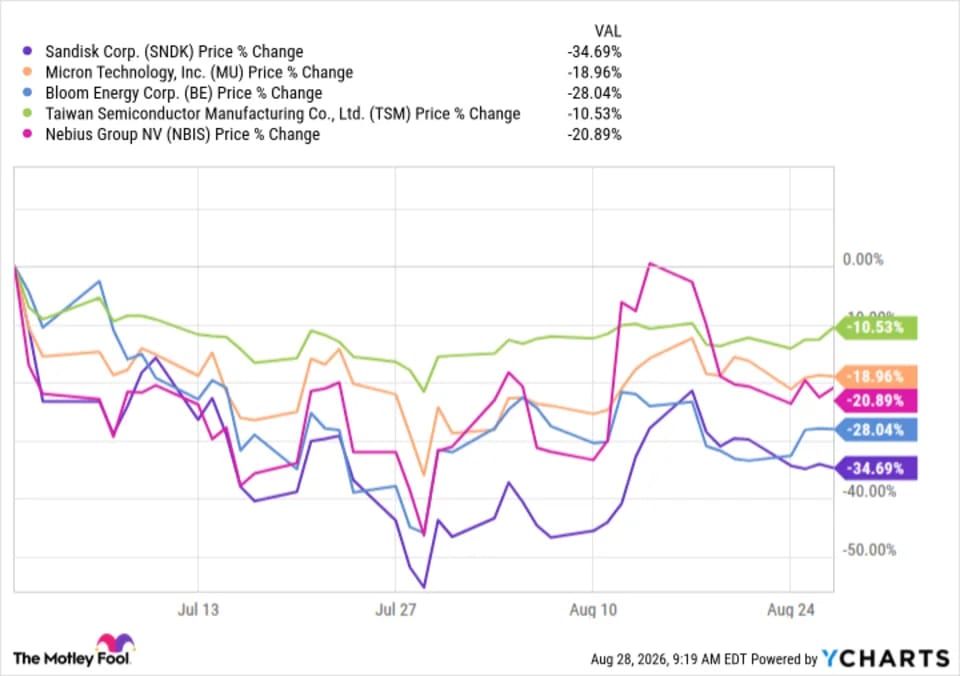
Charlie Dai of the research firm Forrester told CNBC the selloff was "less about weakening AI demand and more about a repricing of expectations." On that view, investors had cut what they would pay for future growth without concluding that the growth was gone. SK Hynix fell 35% in July yet remained nearly tenfold above where it began 2025. The S&P 500, which tracks large U.S. companies, stayed near record highs, CNBC noted, so the damage stayed inside the AI trade.
An investor who owned those stocks outright could have waited, since nobody could demand cash from them. Situational Awareness could not wait, and the reasons lie in decisions made long before July.
The fund was built in a way that could not wait
Aschenbrenner set out his view in June 2024, in a 165-page essay called Situational Awareness about companies racing toward $1T computing clusters. The fund he built on it bet that more powerful AI would need a vast expansion of chips, memory, data centers, and electricity. He chose a hedge fund, a private investment pool that can profit whether prices rise or fall. He picked it over a venture fund because, as one of his investors told Fortune, he wanted to express his ideas "in the most liquid markets in the world."
A liquid market is one where large amounts can be bought and sold quickly without moving the price much. That let the fund grow fast, though it also meant that most of what it owned carried a fresh price every day. By June 2026, the largest positions in its regulatory filings were memory and chip companies such as SanDisk and Micron, which tied its biggest bets to the same trade.
Aschenbrenner then added ‘leverage,' which means borrowing to hold more investments than a fund's own money covers, and CNBC put the fund's leverage as high as 400%. That works out to four dollars of investments for every dollar investors put in, much like buying a house with a 25% down payment. A 25% rise in the price doubles the owner's money, while a 25% fall wipes it out. Borrowing on that scale magnified the gains on the way up, and before July the fund had gained more than 1,000% since launch, CNBC reported, citing the Wall Street Journal.
The lenders were ‘prime brokers,' the units of large banks that lend to hedge funds and hold their securities. A prime broker lends against ‘collateral,' the shares and cash a fund pledges as security, and values that collateral at current market prices every day. When the value falls below an agreed level, the broker issues a ‘margin call,' a demand for more cash or collateral, and a fund without spare cash has to sell. The arrangement resembles a mortgage whose bank reappraises the house every evening and ignores the owner's plan to live there for 30 years. Together, those choices gave the fund's lenders, rather than its manager, control over when it would have to sell.
Hire smarter with Athyna, save up to 70% on salary costs.
Athyna connects you with top LATAM AI talent, fast!
*This is sponsored content
The fund's structure turned a repricing into a fire sale
The fund came out of July with about $10B left, CNBC reported, though its starting size is disputed, with CNBC's sources putting it near $45B and other outlets citing lower figures. Jane Street, a trading firm that had invested in the fund, lost about $15B in July, partly through that stake. The Kospi, South Korea's main stock index, jumped 18% on July 31, 2026, the day after the Citadel sale. That fits the idea that forced selling had been weighing on prices, though no source has established the link.
Critics say the fire sale still reflects doubts about AI
The strongest objection holds that separating the fund's structure from the market's mood is too neat, since the margin calls came only because investors started doubting the AI buildout. Dai himself said investors are reassessing whether AI revenue can justify the spending. Alphabet's shareholders sent its stock down 7% after it raised its 2026 capital spending forecast, its planned outlay on data centers and similar assets. On this reading, a fund built to profit from confidence in AI failed when that confidence slipped, whatever its structure.
The objection holds as far as the trigger goes, because without the doubts that began in Seoul there would have been no margin calls to meet. It would gain force if the largest cloud companies cut their 2027 spending plans, since that would mean the demand the fund bet on was fading. It weakens on why this fund had to sell, since the same doubts hit every holder of those stocks while only borrowed, daily-priced positions faced demands for cash. Confidence set the timing of the fall, while the fund's structure decided that the fall ended in a fire sale.
The fund changed how it is run and kept its view of AI
Six weeks after the sale, the fund was trading again, still betting on AI though on different terms. On September 11, 2026, CNBC reported it buying options on AMD, CoreWeave, SK Hynix, and SanDisk, the same kind of chip and AI infrastructure stocks it held before July. An option is a contract giving the right to buy or sell a stock at a set price by a set date, and its buyer can never lose more than the upfront price paid. The fund's view of AI looked unchanged, while the most any single options position could lose was fixed on the day it was bought.
Its lenders were adjusting too, since within hours Reuters reported that the bank JPMorgan had stopped lending to the fund. On September 14, 2026, the Bank for International Settlements, a Basel-based body owned by central banks, warned about the growing role of heavily borrowed hedge funds and cited the fund's July crisis. Its concern is structural, since any fund that carries borrowed money into the AI trade hands its lenders the power to decide how long its bets can last.
The market's verdict on AI is still to come
George Bailey kept his firm open by talking depositors into waiting, while Aschenbrenner kept his by selling what his lenders could price. The largest cloud companies report quarterly results in late October, with early signals on their 2027 spending, which will say something about whether confidence in the AI buildout is holding. The fund's third-quarter filing, due by mid-November, will give the first public view of its options positions. Neither will show how many other funds are carrying borrowed money into the same trade, which is the question July leaves for the next time AI stocks fall.
P.S. Want to collaborate?
Share today’s news with someone who would dig it. It really helps us to grow.
Let’s partner up. Looking for some ad inventory? Cool, we’ve got some.
Deeper integrations. If you're after longer-form storytelling, reply to this email, and we can get the ball rolling.
What did you think of today's memo? |
|






.svg)
.svg)