Welcome to Memorandum Deep Dives. In this series, we go beyond the headlines to examine the decisions shaping our digital future. 🗞️
This week, we're going back to nine days in July when Alphabet, Meta, Microsoft, and Amazon each opened their books. Revenue was climbing at all four. Two posted record profits. Investors sent two of the stocks up and two of them down.
The obvious explanation is spending, and it does not hold. All four are pouring an unprecedented share of their cash into AI infrastructure, all four are borrowing to do it, and all four told investors the bill would get larger. If the market were simply punishing capital expenditure, the reaction should have been uniform. It was not.
So investors were reading something else. It sits below the profit line, on a part of the financial statements that barely mattered when software was a business you could run without concrete, and it has a much older precedent than anything in technology. The story starts in Istanbul in 1854.
Modern Pricing Models Break Finance (And How to Fix It)
Usage-based and hybrid pricing models are reshaping B2B revenue and creating real complexity for finance teams. Tabs and PwC break down what it means for rev rec, forecasting, and ops. Watch the on-demand recording for practical frameworks you can actually use.
Sponsored by

The first way to trade directly inside Claude and ChatGPT
For decades, the most powerful intelligence lived behind the closed doors of quant firms — billion-dollar funds whose algorithms quietly out-traded everyone else.
Co-Invest by Liquid is the first way to trade directly inside Claude and ChatGPT. Ask your AI to analyze a market, stress-test an idea, or build a position sized to your comfort level, then execute, right there in the conversation. No jargon. No twelve-screen terminal. No guesswork.
It's built for people who want to invest smarter, not gamble harder. You set the risk tolerance. The AI does the heavy lifting. You approve every trade.
The institutions made the game, Co-Invest gives you a way to beat them.
An empire that promised away its revenue
In 1854, with the Crimean War draining its treasury, the Ottoman government borrowed from foreign lenders for the first time in its history. The empire had enough revenue to service the debt, and many European states were borrowing in much the same way, yet each new loan committed a larger share of future tax receipts before they had even been collected. By the time the financial panic reached the empire in 1873, taxes were still arriving in Istanbul, but an increasing share had already been promised elsewhere. The government suspended payments on its foreign debt in 1875, defaulted the following year, and in 1881, the Decree of Muharrem placed roughly a quarter of Ottoman state revenue under an administration representing foreign bondholders, leaving the treasury with less control over money that continued to flow in.
The years after the default exposed a second problem. British bondholders pressing for government intervention could not even agree on the size of the Ottoman debt because every calculation depended on assumptions about how much of each loan had reached Istanbul and how much had been lost to commissions and fees. The accounting itself became contested, making both the pre-commitment of future income and the measurement of those commitments central to understanding the empire's finances.
Modern accounting captures the first of those ideas through free cash flow, the cash a business has left after paying both its operating costs and the investments needed to expand. For much of the software era, that measure attracted little attention because growth required relatively little physical investment. Code scaled without factories or railways, revenue rose faster than the cost of serving it, and profit and free cash flow generally moved together, leaving companies with ample surplus for dividends and buybacks.
The software industry’s accounting has changed
However, in 2026, artificial intelligence has transformed the investment side of the free cash flow equation, as expanding an AI business now requires land, power, and hardware on a scale the software industry has rarely seen before. And the consequences of this shift became unmistakable over nine days in July 2026, when the largest technology companies reported earnings.
Alphabet reported first on July 22. Its business was accelerating, with revenue climbing 24% to $119.8B and Google Cloud revenue up 82% to $24.8B, but it spent faster than it generated cash. Operations produced $39.1B during the quarter, while the company invested $44.9B in building AI infrastructure, resulting in negative free cash flow of $5.9B for the first time since its 2004 listing. Management raised full-year capital expenditure guidance to $195B to $205B, its second increase of the year, while issuing new debt and equity and halting share buybacks. The shares fell about 5%.
Another Big Tech company, Meta, told a similar story a week later. While the company's revenue rose 28% to $60.8B, almost every dollar of cash generated was immediately reinvested in AI infrastructure. Capital expenditure of $31.08B absorbed 98% of operating cash flow, reducing free cash flow to $784M from $8.55B a year earlier. The company also paused buybacks, borrowed $24.91B during the quarter, and paid $1.35B in dividends.
Microsoft generated $55.4B in cash from operations and committed $41B to AI infrastructure, though only $35.8B of that left the business as cash during the quarter, leaving free cash flow of $19.6B. At the same time, Azure revenue grew by 43%, providing evidence that the new data centers were already driving faster growth. Amazon looked even more aggressive on paper, spending $54.2B on infrastructure against $45.4B of operating cash flow, yet AWS grew 37%, its fastest pace in 18 quarters, convincing investors that today's spending was translating into tomorrow's business.
Investors sorted the four companies differently. Meta fell as much as 10% in after-hours trading and Alphabet about 5%, while Microsoft and Amazon both rose, even though all four were devoting an unprecedented share of their cash to AI infrastructure and increasingly turning to debt to finance the buildout. If spending alone did not explain the market's verdict, what did?
Outperform the competition.
Tools & resources, ranging from playbooks, databases, courses, and more.
Deep dives on famous visionary leaders.
Interviews with entrepreneurs and playbook breakdowns.
*This is sponsored content
Earnings no longer tell the whole story
The answer begins with the limits of reported earnings. Quarterly profit had become a poor guide to the underlying business because each company's results were increasingly shaped by investment gains, one-off charges, and accounting adjustments rather than day-to-day operations.
Alphabet reported net income of $112.1B, but a $99.0B gain on equity securities contributed $77.1B of that figure after tax and added $6.26 to earnings per share, none of it cash. Amazon's $62.6B in net income included $53.4B of non-operating pre-tax income, largely reflecting the rising value of its stake in Anthropic, while Meta's profit fell 14% after absorbing $2.40B of legal charges and $1.18B of severance costs. Once reported earnings are dominated by non-cash items, investors naturally shift their attention to free cash flow, which more closely answers the question they actually care about: how much cash the business generated after paying to operate and expand.
Even that measure, however, was not enough on its own. The earnings suggested investors were asking a different question: whether today's infrastructure spending was already translating into stronger business performance. Amazon answered that through AWS, whose revenue grew 37%, its fastest pace in 18 quarters, while AWS's operating margin widened from 32.9% to 39.4%, showing the business was becoming more profitable as investment increased.
Microsoft paired $41B in capital expenditure with 43% Azure growth and guidance pointing to further acceleration in the following quarter. Alphabet had the strongest evidence of the four, with cloud revenue growing 82%, and its shares still fell, after management raised full-year spending guidance for the second time in six months and warned of a further increase in 2027. Evidence earned the company credit; asking for more money in the same breath, it spent it. Meta offered no guidance for next year at all, leaving investors without the evidence or a timetable for when it might arrive.
Free cash flow cannot measure conviction
The companies argue that even this comparison captures only part of the picture. Free cash flow is measured over a single reporting period, whereas the data centers and related infrastructure being built today are expected to generate returns over many years. Alphabet points to a cloud backlog of $514B in contracted business as evidence that much of its planned capacity already has customers waiting, while both Microsoft and Amazon say demand continues to exceed available supply. From that perspective, today's reduction in free cash flow reflects the timing of investment rather than its eventual economic value.
That argument still leaves investors with a difficult question. Free cash flow records the cost of a data center as soon as the money is spent, but it may take years before anyone knows whether that facility becomes a highly profitable asset or an expensive mistake. Microsoft and Amazon already have cloud businesses generating revenue from similar infrastructure, giving investors evidence that their spending is paying off. Meta is asking investors to take more on faith. Meta CEO Mark Zuckerberg argues that the larger opportunity lies in AI products and services rather than renting computing power in the cloud, meaning the payoff from today's investment may not be reflected in the company's financial results for years.
That is what makes free cash flow a harder number to interpret than it first appears. It tells investors how much cash a company has left after investing, but not whether those investments will ultimately earn an attractive return. At that point, the calculation becomes less about accounting and more about trust. Investors have to decide whether they believe management's explanation that today's spending will become tomorrow's profits.
The hidden balance sheet
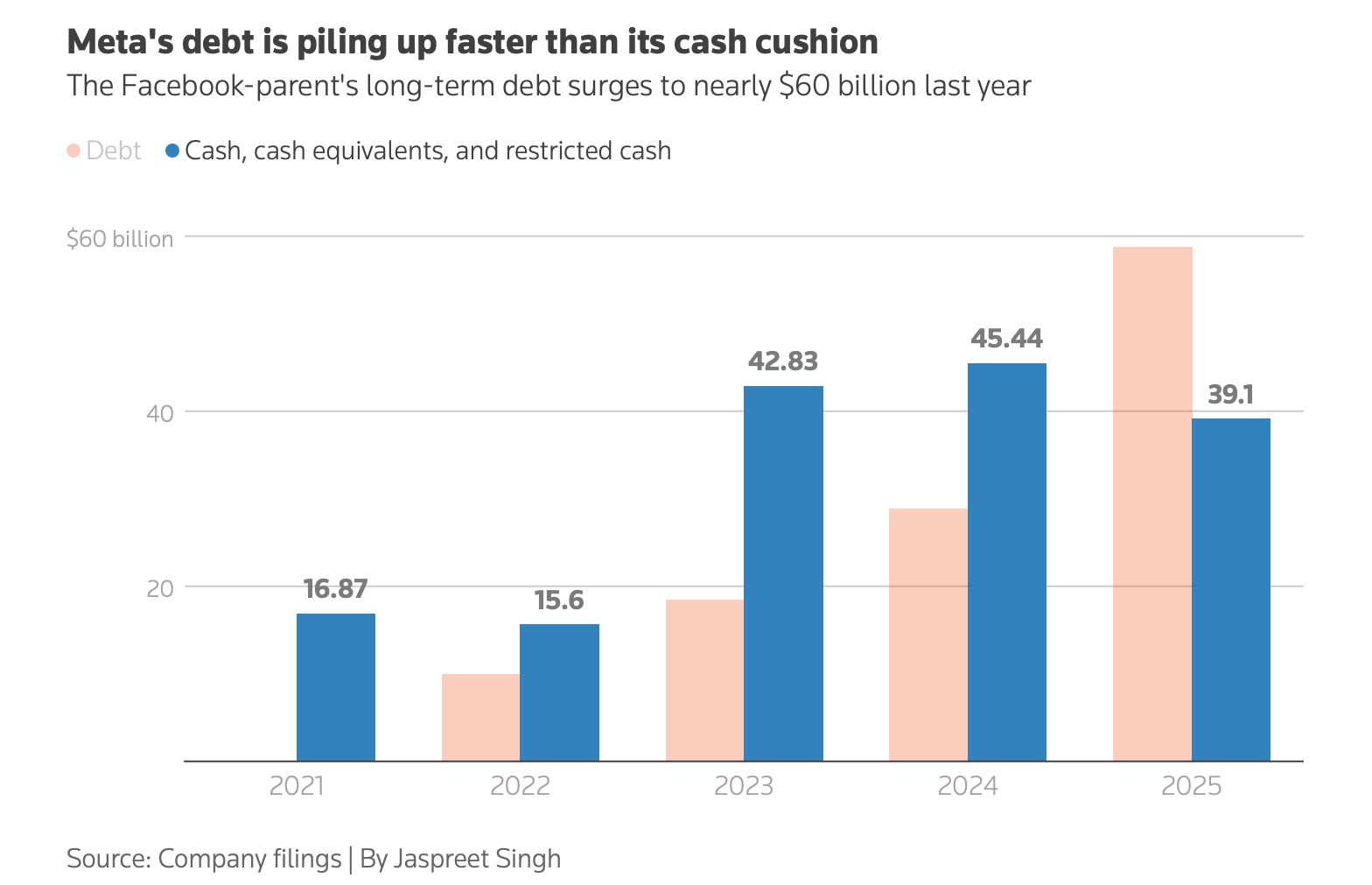
The commitments, however, continue to accumulate whether investors believe that story or not. Meta's own guidance implies capital expenditures of between $79B and $94B in the second half of the year, against operating cash flow of roughly $32B a quarter. Across the industry, companies are increasingly financing that expansion with borrowed money. S&P Global counted $169B of rated hyperscaler debt raised in the first half of 2026 alone, more than it had assumed for the whole year, and now expects $250B to $300B by December. The obligations are real and measurable. What remains uncertain is whether the returns will eventually justify them.
None of this means the AI buildout is misguided. The companies making these investments remain highly profitable, demand for AI computing continues to exceed available capacity, and much of the infrastructure is expected to generate returns for decades. The difficulty is that not all of the commitments appear in the same place.
Meta's filings list roughly $279B in lease obligations for data centers and network capacity that have yet to come into service. The day before reporting earnings, the company announced a roughly $14B data center venture with BlackRock, under which outside investors will finance most of the construction and Meta will lease back the completed campus.
P.S. Want to collaborate?
Share today’s news with someone who would dig it. It really helps us to grow.
Let’s partner up. Looking for some ad inventory? Cool, we’ve got some.
Deeper integrations. If it’s some longer-form storytelling you are after, reply to this email, and we can get the ball rolling.
What did you think of today's memo? |
|









.svg)
.svg)