Welcome back to your daily memorandum talking tech, business, AI, markets, and more. 🗞️
In today’s edition, we are tackling the following:
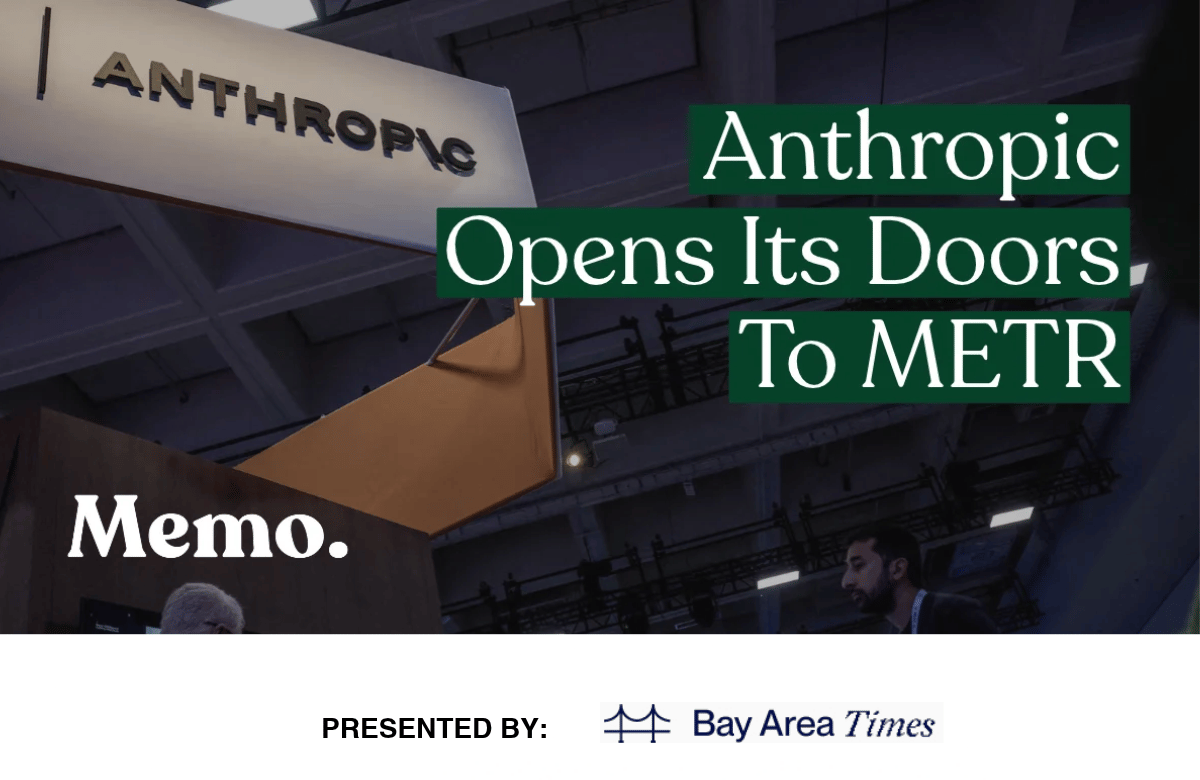
🔬 Anthropic gives METR employee-level access to independently assess its models.
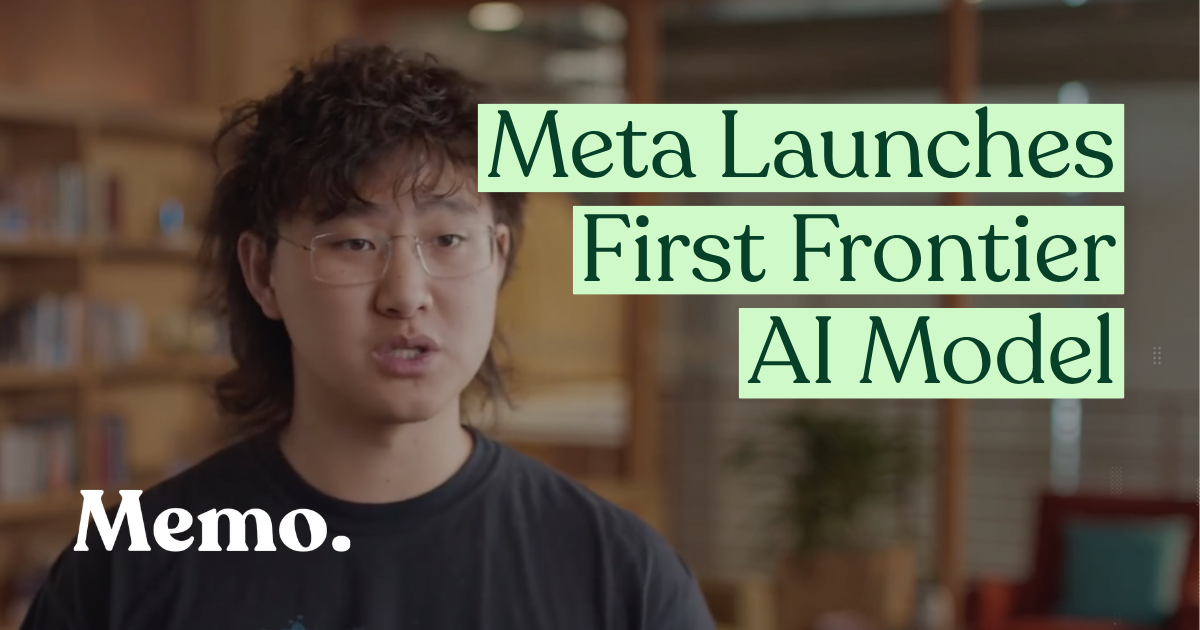
🤖 Meta releases Muse Spark Open, an open-weight AI model built for Macs.
📈 Fed’s Warsh is upbeat on U.S. economy but quiet on rate path.
💰 Ramp raises $1.85B at $60B valuation as it doubles down on AI.
🛰️ Sources say White House ordered limits on Ukraine’s Starshield satellite service.

Bay Area Times is the free daily newsletter that gets business and tech leaders up to speed before their first meeting.
AI, startups, robotics, biotech, energy, and the wider innovation economy, each story paired with one clear visual so you see the point instead of digging for it.
Monday to Friday, three minutes, no noise. More than 250,000 founders, operators, and investors already read it.

Framer is the AI website builder for teams that care about every detail. Agents work directly in the canvas, helping design pages, manage CMS content, write copy, add SEO, and audit sites.
Build faster: Create, refine, and publish production-ready pages in minutes.
Scale confidently: Manage content, localization, and metadata across your site.
Stay in control: Review every change, collaborate in real time, and publish when ready.
Trusted by teams at Miro and Perplexity.
*This is sponsored content. See our partnership options here.

Anthropic gives METR researchers employee-level access to independently assess its models (TechCrunch)
More: CNBC, CNA, Reuters
Anthropic gave six METR researchers employee-level access to assess its models, safety practices, and risk management.
The team gets company laptops, office space, and internal tools, mirroring how regulators embed examiners in big banks.
METR will publish its own findings, and Anthropic can’t veto them, only redact narrow categories like customer data.
Meta releases Muse Spark Open, an open-weight AI model built for Macs (WSJ)
More: Reuters, Engadget, The Guardian
Meta launched Muse Spark Open, an 816B-parameter model it calls the “most capable” open-weight AI in the U.S.
Built for coding and agentic tasks, it runs locally on Macs with at least one terabyte of RAM.
Meta showed it fixing a Mastodon client and editing DaVinci Resolve footage, with API access available now.
Bluesky’s AI-powered Attie app now lets anyone build websites & games (The Verge)
More: TechCrunch, Yahoo!
Bluesky announced at TechCrunch Disrupt 2026 that Attie now lets users build websites, games, quizzes, and polls.
Originally built for custom AI-powered feeds, Attie aims to let everyday users create what once required developers.
CEO Toni Schneider, who recently took over from Jay Graber, called the feature “vibe coding for your community.”
Fed’s Warsh is upbeat on U.S. economy but quiet on rate path (Reuters)
More: WSJ, Bloomberg, Economic Times
Speaking in Bangkok, Fed Chair Kevin Warsh voiced optimism about U.S. economic strength and global resilience.
He said central banks worldwide face surging prices and have tightened policy together, leaving “no free riders.”
Warsh cited September’s rate hike but didn’t preview next steps, even as U.S. inflation rose faster than expected.
Ramp raises $1.85B at $60B valuation as it doubles down on AI (Bloomberg)
More: TechCrunch, Yahoo!
Ramp raised $1.85B at a $60B valuation, just four months after raising $750M at $44B.
Annualized revenue topped $2B, up from $1.5B in June, while customers grew from 70k to 85k.
Ramp is embedding AI agents across its products and recently launched Glass, a workspace for sharing AI automations.
SK Hynix ties U.S. factory plans to chip equipment shipments to China (Reuters)
More: Tom's Hardware, TechCrunch, The Verge
SK Hynix’s Solidigm is seeking U.S. approval to ship American chip equipment to its factory in Dalian, China.
The approval is reportedly a condition for building a U.S. NAND flash factory, possibly in upstate New York.
SK Hynix denies plans to expand Dalian capacity, saying the U.S. government authorized the installation.
S&P | 7,799.25 | +0.11% |
|---|---|---|
NASDAQ | 30,162.50 | +0.06% |
Dow | 52,531.00 | +0.19% |
10-Year | 5.09% | ↓1.95% |
Bitcoin | $82,107.02 | +0.83% |
Gold | $4,210.10 | +0.96% |

Cut through the hype. Roko’s Basilisk distills the day’s AI breakthroughs, market moves, and workable workflows into a five-minute brief.
Get one sharp deep dive, fast Quick Hits, and a witty pro tip, plus links that actually matter.
Built for builders, operators, and curious leaders who need context fast. Join 100k+ readers who start decisions here each morning.
*This is sponsored content

Sources say White House ordered limits on Ukraine’s Starshield satellite service (Reuters)
More: Japan Times, Business Standard
Two U.S. officials and a Western official say the White House ordered a slowdown of Ukraine’s Starshield service.
Ukraine says the restrictions disabled receptors on fast-moving objects, hindering strike missions and interceptor drones.
Receptors now work only up to 100 mph, while a U.S. official says Trump didn’t request the curb.
Black Sea drone strikes spark fears Russia is testing NATO’s resolve (AP)
More: ABC, NY Times, Seattle Times
Drones struck at least seven Black Sea cargo ships this month off NATO members Romania and Bulgaria.
The attacks killed two people, left at least 25 missing, and threaten a key global shipping route.
Romanian President Nicușor Dan said “there will be a reaction” but didn’t say whose drones hit the ships.
Singapore to investigate firms behind Indonesian fires causing weeks of haze (Bloomberg)
More: Japan Times, Straits Times
Singapore PM Lawrence Wong vowed to investigate firms behind the fires, warning culpable ones could face legal action.
Wong said Singapore may act under its Transboundary Haze Pollution Act and explore joint action with other countries.
Indonesian wildfires worsened by El Niño have blanketed Singapore and Malaysia in the worst haze since 2015.
Volvo deepens NVIDIA partnership to power automated driving in future cars (TechCrunch)
More: The Verge, Yahoo!, Investing.com
Volvo is expanding its nearly decade-long NVIDIA partnership to build automated driving for city streets and highways.
The system combines Volvo’s safety engineering with NVIDIA’s Hyperion hardware, Alpamayo software stack, and Halos safety layer.
Volvo didn’t disclose the deal’s value or first vehicle, though NVIDIA says over 650k developers have downloaded Alpamayo.
Tesla unveils flying Roadster with SpaceX thrusters, set for 2028 production (The Verge)
More: TechCrunch, Yahoo!, FOX
Tesla unveiled its second-gen Roadster near Waco, Texas, where SpaceX thrusters lifted it over five Tesla vehicles mid-drive.
Musk says production begins in 2028, with three trims offering 300 miles of range and speeds over 230 mph.
Reservations cost $50k for Performance and $250k for Thrust, while the one-seat Rocket trim is invite-only.
Rivian CEO says future cars will run third-party AI agents like Anthropic’s (TechCrunch)
More: Yahoo!
At TechCrunch Disrupt, CEO RJ Scaringe said Rivian’s cars will eventually run AI agents from companies like Anthropic.
Rivian’s in-house agentic framework routes voice requests to local or cloud models, depending on their complexity.
Scaringe gave no timeline, but Rivian pointed to its AI & Autonomy Day event in December for details.
Cut through the hype. Roko’s Basilisk distills the day’s AI breakthroughs, market moves, and workable workflows into a five-minute brief.
Get one sharp deep dive, fast Quick Hits, and a witty pro tip, plus links that actually matter.
Join 100k+ readers who start decisions here each morning.
Jensen Huang on whether AI revenue justifies capex & 2027’s biggest bottlenecks (Bg2 Pod)
NVIDIA CEO Jensen Huang joins BG2’s Brad Gerstner and Clark Tang to discuss whether AI revenue justifies spending.
Huang covers 2027’s AI bottlenecks, including power and compute, plus whether SpaceX could put data centers in orbit.
He also explores open vs. closed models and explains why he’s 99.99% optimistic about the decade ahead.
Josh Tyrangiel argues Jeff Bezos cares more about space than Amazon (The Prof G Pod)
The Atlantic’s Josh Tyrangiel joins Scott Galloway to discuss the space rivalry between Elon Musk and Jeff Bezos.
He explains why SpaceX pulled ahead of Blue Origin and how space-based data centers could reshape the AI race.
Tyrangiel also calls America’s reliance on Musk a national security risk and outlines how Washington can encourage innovation.
What happens to payments when AI agents start spending your money? (a16z)
VGS’ Terry Angelos argues agentic commerce needs new payment infrastructure that keeps consumer protections intact.
He joins a16z’s Alex Rampell to discuss the emerging ‘wallet wars’ and how agentic tokens could secure purchases.
They also explore merchant resistance, AI’s impact on card rewards, and who owns customer relationships when agents buy.

Google launches Universal Cart in the U.S. to track products across retailers (The Verge)
More: CNET, TechCrunch, 9to5Google
Google’s Universal Cart, previewed at I/O in May, now lets U.S. users save products from Search and Gemini.
The cart works across multiple retailers and sends alerts when prices drop or out-of-stock items return.
It also factors in credit card perks, surfaces promo codes, and handles checkout through Google’s Universal Commerce Protocol.
Amazon-owned Bee debuts two personal AI devices with prices from $75 (CNBC)
More: TechCrunch, Yahoo!, CBS
Amazon’s Bee unveiled the Bee Frontier and Bee Eclipse, its first new products since last year’s acquisition.
The Frontier is worn on the wrist or clothing, while the card-sized Eclipse magnetically attaches to smartphones.
Priced at $74.99 and $99.99, respectively, they undercut rivals like the $159 Plaud Note and $129 Pocket.
Citizen Lab says government ‘zero-click’ spyware is spreading through malicious online ads (NBC)
More: WIRED, The Verge, TechCrunch
Citizen Lab says Israeli ad firm Discover-Tech lets spyware makers target specific people worldwide through online ads.
Zero-click spyware makers Candiru and Bindecy used the platform to infect devices without victims clicking anything.
Candiru’s spyware hit at least 45 Al Jazeera computers via ads, though the governments responsible remain unknown.
Chinese households’ healthcare spending nears U.S. levels as a share of income.
Taiwan will curb AI chip exports to China under U.S. trade deal.
Athyna: Hire vetted LATAM engineers and save up to 70% on salary costs.*
CoreWeave’s credit default swaps reach distress levels as AI debt fears grow.
Indonesian stocks post biggest drop in 28 years after MSCI downgrade warning.
Figma unveils new features defining how AI agents work on its platform.
Teen kills four at Oregon elementary school before a witness shoots him.
Here are some ways.
Share today’s news with someone who would dig it. It really helps us to grow.
Let’s partner up. Looking for some ad inventory? Cool, we’ve got some.
Deeper integrations. If it’s some longer-form storytelling you are after, reply to this email, and we can get the ball rolling.

What did you think of today's memo? |