Welcome to Memorandum Deep Dives. In this series, we go beyond the headlines to examine the decisions shaping our digital future. 🗞️
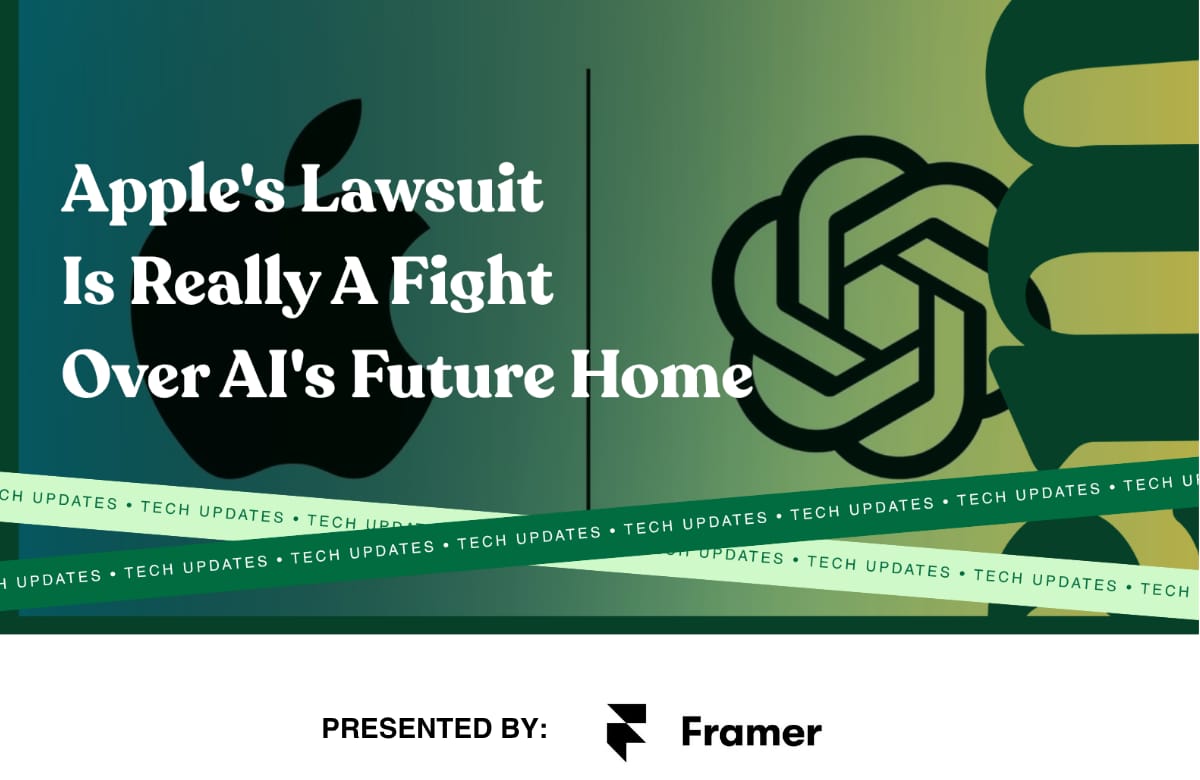
This week, we're digging into a lawsuit that reads like a corporate spy thriller. On July 10, 2026, Apple filed a 41-page complaint against OpenAI in a California federal court, alleging stolen documents, smuggled hardware, and job interviews that doubled as intelligence-gathering sessions. On paper, it looks like a familiar Silicon Valley story: a company accusing a rival of poaching its people and taking its secrets with them.
But the two companies at the center of this dispute were partners not long ago. In 2024, Apple put ChatGPT inside the iPhone, and the arrangement seemed to suit both sides. Now they are facing each other in court, and the allegations flying between Cupertino and San Francisco suggest the relationship soured for reasons that go well beyond a few departing employees.
Because underneath the claims about laptops, logic boards, and 'show and tell' sessions sits a much bigger question, one that neither company can afford to answer wrong. It's a question about the next decade of computing, and this lawsuit may be the clearest signal yet of how the industry's biggest players intend to fight over it.
Build your website on Framer - Now with Agents.
Framer is a pro website builder trusted by companies like Miro and Perplexity that helps creators, teams, and businesses ship production-ready sites faster than ever.
With AI agents built directly into the canvas, teams can design pages, manage CMS content, write copy, add SEO, and audit for issues — all without leaving the tool where the real site lives.
Goodies delivered straight into your inbox.
The oldest playbook in tech meets a new fight
Within the technology industry, companies have long accelerated innovation through two well-established strategies: acquiring startups outright and recruiting top talent from competitors. While both approaches are deeply embedded in the industry's playbook, they do not always produce clean transitions. Instead, they often spill into legal disputes that reveal far more about the industry than either side intends.
One such dispute emerged in July 2026, when Apple sued OpenAI. At first glance, it appears to be another trade secrets and employee-poaching case. Yet the lawsuit may prove to be something more significant: a window into the AI industry's next competitive battleground and how its biggest players envision the future of artificial intelligence.
At the core of that contest lies a simple question: through what device will people primarily access AI, and who will control the hardware that delivers it? Until now, large language models have had no natural home, reaching users through whatever screen happens to be closest rather than a device built specifically around AI. Hardware neutrality was long seen as an advantage, enabling AI assistants to run on phones, laptops, browsers, and speakers. But as technology companies race to define AI's next chapter, the assumption that intelligence can remain detached from hardware is increasingly being challenged.
The partners who each wanted the other's half
From 2024 to 2025, Apple and OpenAI worked together and agreed to integrate ChatGPT into the iPhone so that Siri could pass its hardest questions to a smarter system. The arrangement worked because it put OpenAI's model inside Apple's hardware and left the deeper bargain about physical distribution unspoken. However, the partnership lasted only as long as both sides accepted that division of labor, and it began to fray once each concluded that the other's half was worth owning outright.
The dispute between the companies burst into public view on July 10, 2026, when Apple sued OpenAI, alleging that the AI company orchestrated a coordinated effort to obtain Apple's confidential hardware information as it pursued ambitions to build its own AI devices.
According to the complaint, two former Apple employees, including hardware executive Tang Tan, who are now working at OpenAI, were instrumental in sharing sensitive inside information with their new employer.
Apple argues that OpenAI's hardware initiative was built on improperly obtained trade secrets. OpenAI, meanwhile, has denied the allegations, stating that it has no interest in competitors' confidential information and remains focused on developing its own products.
However, what makes the case particularly interesting is that it reflects a defining feature of the AI era. Unlike previous waves of computing, which were built around new hardware platforms, large language models spread across existing phones, browsers, and operating systems rather than requiring their own devices. That portability made AI ubiquitous, but it also left an important strategic question unresolved: who ultimately controls how people experience it?
Hire smarter with Athyna, save up to 70% on salary costs.
Athyna connects you with top LATAM AI talent, fast!
*This is sponsored content
Deciding where intelligence lives
The answer to that question is now being contested through the lawsuit that reflects two competing visions for where AI assistants should live, with Apple and OpenAI placing fundamentally different bets.
Apple's strategy begins with the assumption that AI does not need a new home. Instead, it believes the smartphone will remain the primary gateway to digital intelligence, provided it is powered by a capable enough model. That thinking became clear in January 2026, when Apple agreed to license Google's Gemini models to overhaul Siri. The move was both an acknowledgment that Apple's own models were not yet competitive and a reaffirmation that the iPhone, not a new hardware category, would remain the center of the AI experience.
OpenAI, meanwhile, is betting on the opposite outcome. Rather than treating the smartphone as AI's permanent home, it is trying to build a successor. That ambition became evident with its $6.4B acquisition of Jony Ive's hardware startup, io, in May 2025. The company has since directed the team toward building a screenless, audio-first AI device, reportedly manufactured by Foxconn, with production targets of 40 to 50M units in its first year. Those ambitions suggest OpenAI sees the product not as a niche experiment but as the foundation of a new computing platform.
The lawsuit is therefore about more than confidential files or departing executives. It reflects a broader contest over where artificial intelligence will ultimately find its home: within the devices people already own or in an entirely new generation of hardware designed from the ground up for an AI-first world.
The stakes extend far beyond another consumer device. Every technological shift is defined by the company that controlled its primary interface: Microsoft with the PC, Apple with the smartphone, and Google with the gateway to information. Owning that interface has meant owning the surrounding ecosystem, from developers and services to user attention. The real contest between Apple and OpenAI is therefore not just where AI runs, but who controls the front door through which billions of people will eventually access it.
The contest boils down to a simple asymmetry: Apple owns the hardware but not the model, while OpenAI owns the model but not the hardware. Apple reaches into a billion pockets yet relies on a rival for AI, while OpenAI commands one of the world's most widely used assistants but must build its own device from scratch. The lawsuit is what that imbalance looks like when it turns physical: OpenAI hires hardware talent, and Apple fights to keep it. The challenge for OpenAI is that history has not been kind to companies that have tried to replace the smartphone.
A short and discouraging graveyard
The wager against the smartphone carries a discouraging history. The Humane AI Pin, backed early by Sam Altman, failed to convince consumers that they needed a new AI-first device and was eventually sold to HP for parts. Rabbit's R1 met a similarly lukewarm reception. So far, the smartphone has proved far harder to displace than many AI enthusiasts expected.
The challenge extends beyond consumer habits. AI-first devices remain heavily dependent on cloud-based language models running in distant data centers, while the absence of a display makes many everyday interactions slower or less practical. Reports surrounding OpenAI's first hardware product remain unclear on whether it will operate independently or continue to rely on a smartphone for part of the experience. If the latter proves true, replacing the phone becomes less a reality than an aspiration.
Yet the ambition is understandable because every major computing era has rewarded whoever controlled its primary device. Apple spent nearly two decades building that position with the iPhone. OpenAI is betting that conversational AI can become the next dominant interface, while Apple is betting the smartphone will absorb AI as another defining capability rather than be replaced by it.
That is what gives Apple's lawsuit significance beyond its allegations. The dispute centers on batteries, logic boards, engineering documents, and departing employees, but beneath those details lies a larger strategic conflict over who will control the next gateway to computing. Whether OpenAI succeeds or fails, the lawsuit reveals that Silicon Valley's biggest companies are no longer competing only to build the smartest models. They are competing to decide where those models will ultimately live.
For the past several years, large language models have had no home of their own, reaching users through whichever screen happened to be nearby. Apple and OpenAI are now answering the same question in radically different ways: will AI continue to borrow its body from the smartphone, or will it finally find a home of its own?
P.S. Want to collaborate?
Share today’s news with someone who would dig it. It really helps us to grow.
Let’s partner up. Looking for some ad inventory? Cool, we’ve got some.
Deeper integrations. If it’s some longer form storytelling you are after, reply to this email and we can get the ball rolling.
What did you think of today's memo? |
|







.svg)
.svg)