Welcome to Memorandum Deep Dives. In this series, we go beyond the headlines to examine the decisions shaping our digital future. 🗞️
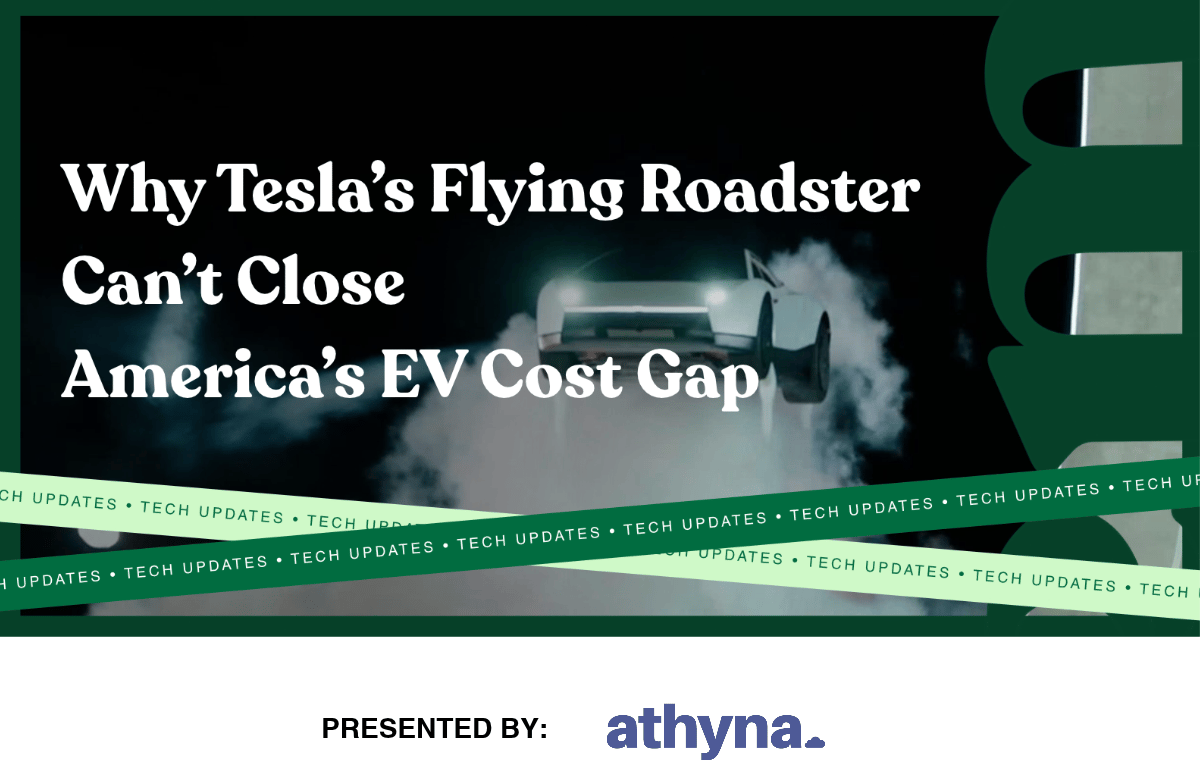
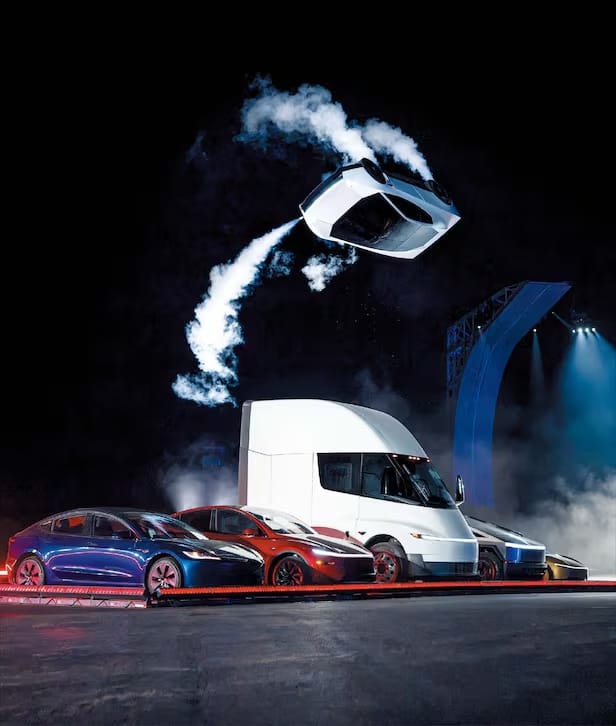
This week, Tesla finally unveiled the Roadster it first promised in 2017, and it skipped the usual test drive. At a SpaceX site in Texas, the driverless sports car drove upside down along a curved ramp, flipped in midair, and used jets of compressed air to hop over a row of other Teslas.
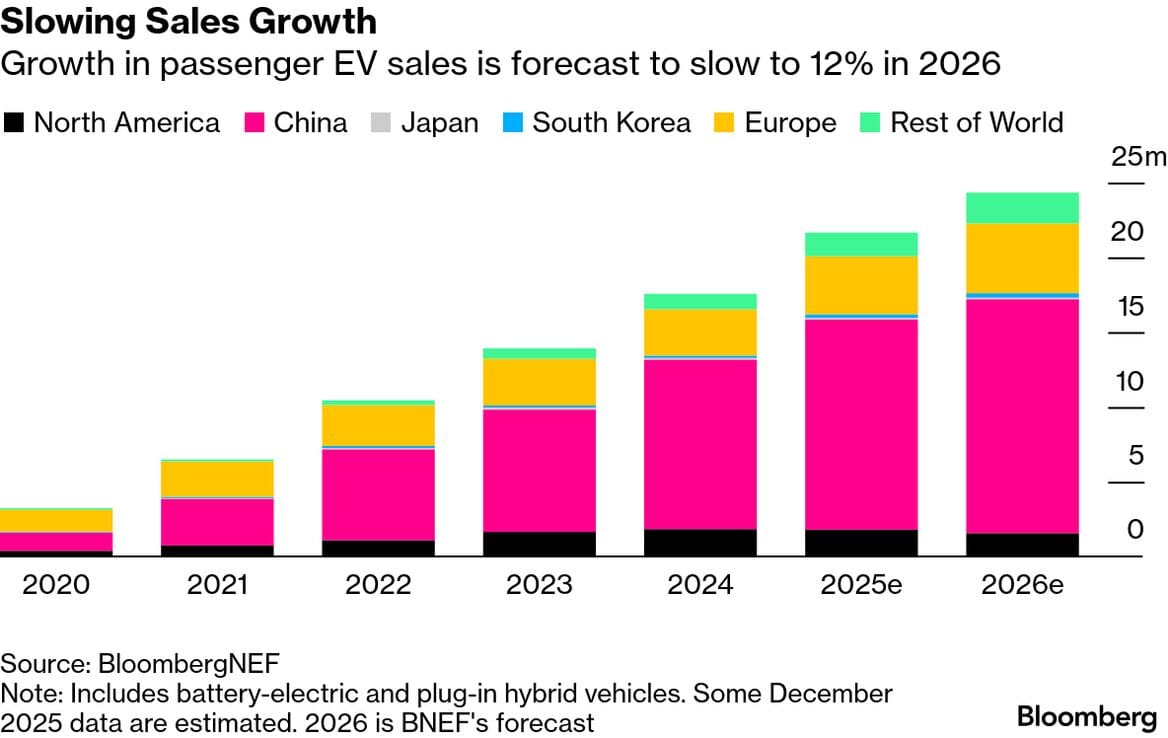
The timing was odd. U.S. EV sales fell nearly 40% from a year earlier in the third quarter, Ford’s EV sales dropped 80.2%, and even Tesla, which still sells more than half of America’s electric cars, lost about a fifth of its volume. Yet the company spent its big night on a car with no price and a 2028 production target.
Wall Street barely blinked, and the reason has little to do with thrusters. Tesla’s everyday cars face a challenge no flying car was ever built to solve, and it looks very different depending on which side of the U.S. border you stand on.
Meet your next hire in as little as five days.
Goodies delivered straight into your inbox.
Tesla’s flying car lands in a shrinking market
On the evening of October 15, 2026, at SpaceX’s test site near Waco, Texas, Tesla sent its new Roadster up a curved ramp with nobody behind the wheel. The car flipped upside down in midair and came back down on its wheels, steadied by small jets of compressed air, and then used the same jets to hop over a row of five Tesla vehicles, including the Model 3, the Model Y, and the Cybertruck. Those three are the cars that pay Tesla’s bills, so for a few seconds the company’s most exotic product hung directly above its most ordinary ones.
Those ordinary cars are the source of Tesla’s strength in America, since Kelley Blue Book, the car-valuation arm of Cox Automotive, estimates Tesla took 54% of U.S. EV sales in the third quarter of 2026. A company that sells more than half of a country’s electric cars shapes where that market goes, so the products Tesla chooses to show off say a lot about the future of American EVs. That future looks shaky, because the market shrank 38.6% in a year after the $7.5k federal EV tax credit expired on September 30, 2025. Tesla’s own sales fell 19.7% over the same period, which looked mild next to Ford’s 80.2% and Chevrolet’s 74.6%.
With its rivals retreating and its own sales falling, Tesla spent its showcase evening on a car with a 2028 production target and no price. Tesla’s shares rose as much as 2.2% the next morning but had fallen 2.13% to $354.72 by the close on October 16. The Nasdaq fell 2.14% the same day, so the close is no clean verdict on the Roadster. What the market did not do is reprice Tesla on the Roadster, and the cars underneath it are the reason, because those cars face a problem a flying car was never going to solve.
The reveal’s failure to lift the stock points attention back to the cars underneath it, because those cars face a problem a flying car was never going to solve, and nobody at Tesla claims otherwise. China’s BYD can build a comparable electric car for thousands of dollars less than Tesla can, even when both companies build in China. American tariffs keep shoppers from ever seeing BYD’s prices, which is a large part of why Tesla still dominates at home. Outside America, those tariffs disappear, and Tesla meets BYD’s prices head-on, so the future of the company holding up American EVs depends on a cost gap the Roadster does nothing to close.
BYD builds a comparable car for thousands of dollars less
The clearest measure of that cost gap comes from Rhodium Group’s February 2026 study, which estimated that BYD builds a comparable car for $4.7k less than Tesla does in China. Rhodium, a research firm that studies China’s economy, built the figure from a cost model, and Rest of World, a tech news site covering markets outside the West, reported the study’s breakdown of the gap. Subsidies from Beijing explain only 5% of it, so the easy explanation that China simply pays for cheap cars accounts for very little. The rest comes from BYD’s size, cheaper engineers, lower running costs, and its habit of making its own parts.
Of those reasons, making its own parts is the easiest to picture, and the industry calls it vertical integration. It works like a restaurant that grows its own vegetables and bakes its own bread, because BYD builds its own batteries, chips, and motors and so never pays a supplier’s markup on them.
Those lower costs showed up in sticker prices, since BYD cut the Seal sedan’s price in China from $30.2k to $24.2k between 2022 and 2025. Over the same three years, Tesla cut the Chinese price of its Model 3 by just $221, a difference the cost gap goes a long way toward explaining.
Those lower prices then turned into more sales, and in the third quarter of 2026 BYD sold 762.5k fully electric passenger cars while Tesla delivered 486.5k cars worldwide. The BYD figure leaves out its plug-in hybrids, which pair a battery with a gasoline engine, so the comparison sets like against like. At face value, a gap that large should have pushed BYD into American showrooms by now, but two decisions made in Washington have kept it out.
250,000 professionals read it before their first meeting.
Bay Area Times covers AI, startups, business, and the innovation economy in a format built for people with no time to spare.
One visual per story, concise analysis under it, and you are done in three minutes. Free, Monday to Friday, and read by founders, operators, and investors across the tech ecosystem.
*This is sponsored content
Tariffs hide the gap at home and leave Tesla exposed abroad
Those two decisions work like two locks on the same door into America. The first is a 100% tariff on Chinese EVs finalized in 2024, which is an import tax as large as the car’s own price, and the second is a rule the Commerce Department finalized in 2025 that bans Chinese-linked software and hardware that connect a car to outside networks. The rule reaches further than the tariff, because it shuts out Chinese-owned brands even if they build their cars in American factories.
Both measures keep BYD’s prices away from American shoppers, but they do nothing to change what it costs to build an EV in America. They don’t guarantee anyone success at home either, since Ford ended production of its electric F-150 Lightning pickup in December 2025 and booked $19.5B in charges across its wider retreat from electric vehicles.
Tesla, on the other hand, has used the same shelter better than anyone else, launching cheaper Standard versions of the Model 3 and Model Y in October 2025 and losing sales at half the pace of the market. That record makes Tesla the biggest winner from the barriers that keep BYD away, which also means it has the most to lose wherever those barriers end.
However, while the tariffs protect Tesla inside the U.S., outside the country they are of little use. That is exactly where BYD is now growing fastest, with Reuters calculating that its September overseas shipments rose 153.9%. In those markets, shoppers see a Tesla and a BYD with no tariff added to either price, and BYD can charge less because it builds a comparable car for about $4.7k less.
Nothing Tesla showed in Waco changes what a Model Y costs to build, which raises a fair question about why the company spent its big evening on a flying car at all. Tesla’s defenders have an answer: the Roadster was never meant to fix the cost of a Model Y, because it was built to do a different job.
The halo car argument holds on strategy and weakens on trust
The job the defenders have in mind is the one done by a halo car, which is a car built in small numbers and sold at high prices to make the whole brand look good. Elon Musk said at the event he is “not sure it moves the needle massively” on revenue, which is how a company talks about a car built for that job.
Analysts outside the company read the car the same way, and Seth Goldstein, an analyst at the investment research firm Morningstar, described it before the reveal as the halo car Tesla currently lacks. Gene Munster of Deepwater Asset Management, which holds Tesla shares, went further and called the event “an engineering flex with no commercial value beyond embarrassing traditional car makers.” Tesla had also launched its cheaper Standard trims a full year before the reveal, so on strategy the defenders have a point, because the everyday cars were not left waiting on the Roadster.
A halo car can only lift a brand if buyers believe it will arrive, and that is where the defenders’ case weakens. Tesla first showed this Roadster in 2017 and promised deliveries in 2020, then delayed it four more times, in 2020, 2021, 2023, and 2024. Even the reveal itself moved from October 1 to October 15, and the car that finally appeared falls short of the first promise. Tesla now claims a range of more than 300 miles, which Fortune noted is less than half the 620 miles Tesla promised in 2017.
Even the flying part, the thing that made the evening memorable, is the least settled claim of all, because CNN noted that no long-range flight was shown and that flight beyond short hops remains unproven. The flying version, called the Rocket, carries fine print that reads “Not approved for public road use.” Tesla is still taking deposits of up to $250k to hold a place in line for a car with no price, and it has not said how many people have paid.
Without that number, buyers are left to judge the Roadster by the company’s last launch built around spectacle, the Cybertruck, whose estimated U.S. sales fell from 39k in 2024 to 20.2k in 2025. Fortune reported recalls and build-quality problems during that slide, which is the kind of record a halo car has to overcome before it can lift anything.
That record will hang over the Roadster for as long as the car remains a promise, and the car’s cost to Tesla stays out of view too, because the company does not report how much money and engineering the program takes. Whatever it takes could otherwise go into the cars the Roadster jumped over in Waco. Those are the cars that will have to beat BYD on price in every market where America’s locks don’t reach.
P.S. Want to collaborate?
Share today’s news with someone who would dig it. It really helps us to grow.
Let’s partner up. Looking for some ad inventory? Cool, we’ve got some.
Deeper integrations. If it’s some longer form storytelling you are after, reply to this email and we can get the ball rolling.
What did you think of today's memo? |
|