Welcome to Memorandum Deep Dives. In this series, we go beyond the headlines to examine the decisions shaping our digital future. 🗞️
This week, a Reuters/Ipsos poll found that a bipartisan majority of Americans oppose betting on elections, military actions, and government decisions. Three-quarters also said that wagering on real-world events through prediction markets is gambling. Days earlier, the American Gaming Association, the trade group for the country’s casinos, asked the Supreme Court to back New Jersey in its case against Kalshi, a prediction market licensed by federal regulators.
The clash between the casino industry and its new rivals has a surprisingly old backstory. In 1938, a former bootlegger named Tony Cornero anchored a casino ship called the Rex off Santa Monica, just past where California’s gambling laws were thought to end. Water taxis ferried customers out for a quarter. Shutting it down took a future Chief Justice of the United States, a creative reading of the map, and a standoff fought with fire hoses.
That standoff ended with a clear winner. The case now heading toward the Supreme Court may not, and the reason explains how far American betting has traveled since the Rex dropped anchor.
Framer: The AI canvas for the web.
Framer is the AI website builder for teams that care about every detail. Agents work directly in the canvas, helping design pages, manage CMS content, write copy, add SEO, and audit sites.
Build faster: Create, refine, and publish production-ready pages in minutes.
Scale confidently: Manage content, localization, and metadata across your site.
Stay in control: Review every change, collaborate in real time, and publish when ready.
Trusted by teams at Miro and Perplexity.
Meet your next hire in as little as five days.
A floating casino anchored just past the law
In the summer of 1938, anyone standing on the Santa Monica pier could pay a quarter for a water taxi and ride out to a casino that California’s gambling laws could not reach. The casino was the SS Rex, an old ship refitted by a former bootlegger named Tony Cornero, which sat at anchor just over three miles from shore, where state waters were generally understood to end. The roulette wheels on board were the same games police shut down on land, so the only thing separating a legal bet from an illegal one was where the ship sat on the map.
Thousands of Californians were gambling a short boat ride from a state that banned it, so the Rex became a problem for Earl Warren, who took office as California's attorney general in January 1939 and later became Chief Justice of the United States. Warren chose to challenge where the line had been drawn. He argued that Santa Monica Bay was a true bay, so the three miles should run from a line between its two headlands, which put the Rex inside state waters. His officers raided the ship, Cornero kept them off with fire hoses for more than a week before he surrendered, and California’s courts later sided with Warren. The gambling ships disappeared soon after, because in 1939 a bet still had to happen somewhere, and whoever controlled that somewhere controlled the bet.
American gambling followed the Rex’s logic for most of the century that came after it. A bet belonged to a place, whether a desert city, a boardwalk, or a casino on tribal land, and getting to the table meant getting to the place. That logic has now almost disappeared. Betting moved first onto phones, one state at a time, and then onto prediction markets, apps where people buy and sell contracts that pay out if an event happens. Gambling in America has spread from a few licensed places to almost any event that can be written into a contract. The spread is a larger story than this week's poll, because it has changed what Americans can bet on faster than the law has settled who should regulate it.
On October 12, 2026, a Reuters and Ipsos poll of 4,506 adults found bipartisan opposition to betting on elections, military actions, and government decisions, with three-quarters of respondents calling these wagers gambling. Four days earlier, the American Gaming Association, the trade group for the country's casinos, asked the Supreme Court to side with New Jersey in its case against Kalshi, a prediction market licensed by federal regulators. The old gambling industry is now fighting the new one, and the public is uneasy about where the new one has taken the bet.
Gambling meant going somewhere
The first of those places was Nevada, where Governor Fred Balzar signed a bill on March 19, 1931, that legalized wide-open gambling, as the state legislature recorded in a commemorative legislative resolution, and Las Vegas grew up around that law. The next big opening came 45 years later, when New Jersey voters amended their state constitution in 1976 to allow casinos in Atlantic City, as the state recounts in its Supreme Court petition.
Gambling then spread to far more places without ever leaving the building. Native American tribes, which run casinos under federal law and agreements negotiated with each state, now operate 545 venues across 29 states. Those venues earned a record $46.2B in fiscal 2025, the National Indian Gaming Commission reports. State-licensed casinos operate in 38 jurisdictions as well, so gambling had reached much of the country while still asking people to show up in person.
Sports betting was the one large form of gambling that stayed mostly off the map, because a federal law barred most states from allowing it. A fan who wanted to bet on a game legally still had to go to Nevada.
The 2018 ruling put the bet on the phone, one state at a time
The federal ban on sports betting ended on May 14, 2018, when the Supreme Court struck it down in Murphy v. National Collegiate Athletic Association, a case about whether Congress could stop a state from legalizing sports betting. The justices left the choice to each state, and 39 have since chosen to allow sports betting while 11 have chosen not to, according to New Jersey's Supreme Court petition (New Jersey is a party to the Kalshi case).
The states that said yes put betting on phones, and the money that followed was large. In 2025, Americans wagered $166.94B on sports with state-licensed operators, which kept $16.96B after paying out winnings, while online casino games such as slots and blackjack kept another $10.74B, according to the American Gaming Association. In-person gaming still produced $50.94B, about 65% of the record $78.72B total, so the phone grew a new business around the casinos while the casinos kept most of the money.
The phone also kept one old rule from the Rex’s era in place. A licensed sportsbook app works only inside a state that has approved it, so a fan in one of the 11 holdout states still has no legal way to bet on Sunday’s game.
Prediction markets carried the bet across state lines
Prediction markets broke that last rule by arriving through a different door. Kalshi holds a license from the Commodity Futures Trading Commission, or CFTC, the federal agency that oversees futures contracts, such as those a wheat farmer uses to fix the price of next season's harvest. That license lets Kalshi list new contracts without waiting for anyone's approval. After winning a federal court ruling in September 2024 that let it offer contracts on elections, Kalshi moved into sports in January 2025, pitching itself as the first nationwide sports betting app.
A fan who expects the Chiefs to win would struggle to tell the new product from a traditional sportsbook bet. At a sportsbook, $60 placed with a bookmaker returns about $100 if the Chiefs win; on Kalshi, $60 buys 100 contracts paying $1 each if the Chiefs win. Kalshi calls its contract a swap, a financial product that federal law places under the CFTC alone, which could place it beyond the reach of state gambling laws, including in the 11 states that did not authorize it.
DraftKings and FanDuel launched prediction-market apps of their own in December 2025, which, as Bloomberg reported then, let them offer federally regulated betting in states that had not legalized online gambling. Fans took up the offer. A federal appeals court found that 90% of Kalshi's 2025 trades were tied to sports, according to New Jersey's petition.
The states fought back, and the result is a map that changes at each state line, much as the law around the Rex changed three miles out. After early appeals rulings that went in opposite directions, Kalshi’s contracts are protected in New Jersey but treated as unlicensed betting in Nevada, Ohio, and Tennessee, and New Jersey has asked the Supreme Court to settle the question.
Outperform the competition.
Tools & resources, ranging from playbooks to databases, courses, and more.
Deep dives on famous visionary leaders.
Interviews with entrepreneurs and playbook breakdowns.
*This is sponsored content
The newest bets are on elections, wars, and government decisions
The same license that carried sports bets across state lines also carried betting into public life, because a contract can be written on any event with an answer. Prediction markets now list thousands of contracts on the November 3 midterm elections, alongside wagers on military actions and government decisions. These bets remain a small part of the money, and nobody has published a reliable count of how fast their share is growing.
Bets on public life are, however, where the documented harm has appeared, because a contract on a government decision can be bought by someone who already knows the answer. Federal prosecutors charged Gannon Ken Van Dyke, an Army special forces soldier, with using what he knew of the January 3 operation to capture Venezuelan leader Nicolás Maduro to bet on Polymarket, another prediction market. He allegedly made more than $400k, in what NPR called the first U.S. criminal case over such wagers. George Santos, the former congressman, later agreed to pay $35k to resolve CFTC allegations that he traded on his own attendance at the State of the Union.
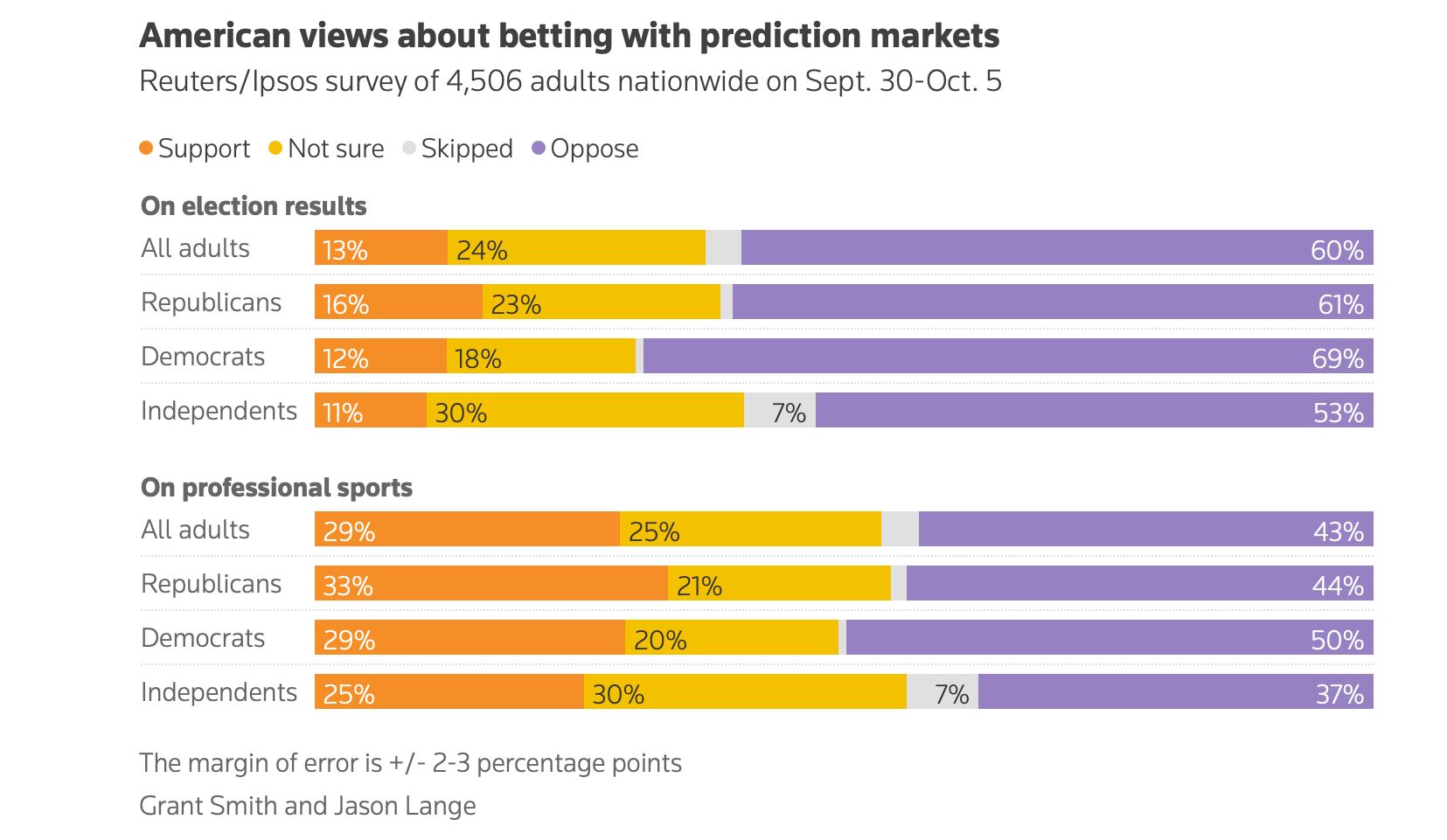
Public opinion follows those cases, and in the Reuters/Ipsos poll, 69% of Democrats and 61% of Republicans opposed betting on elections. Some 65% of respondents opposed betting on military actions, and 63% opposed betting on government decisions. Opposition to sports betting was softer, at 43% opposed and 29% in favor, which indicates Americans have grown used to wagering on games while drawing a line at wagers on the decisions that govern them.
Defenders say the markets inform as much as they gamble
Kalshi and its defenders say the gambling label misses what these markets do, and that incumbents use it to protect their licenses. Kalshi Chief Executive Tarek Mansour told Axios that calling his contracts gambling would mean calling the whole financial market gambling. Their strongest evidence is a 2026 Federal Reserve Board working paper, which found that Kalshi’s forecasts for the Fed’s main interest rate and for inflation beat both the futures market and the economists Bloomberg surveys. Polymarket told Reuters that more than 90% of visits are to view its markets rather than to trade, and the defenders note that Kalshi itself flagged the Santos trades.
The defense holds for contracts on the economy, which do appear to turn scattered guesses into useful forecasts. It weakens once the whole business is in view, because the Fed paper studied a kind of contract that the court record suggests is a sliver of what Kalshi sells, while sports made up 90% of its trades. A good forecast also does nothing about the risk the public objects to, since a market that predicts a military operation well is a market that rewards whoever knows about the operation first.
The table now reaches past the casino floor
Cornero’s scheme rose and fell on a single principle, which was that whoever controlled the place where a bet happened controlled the bet. Warren never had to argue about roulette, since he only had to move a line on the water, and once the courts accepted his line, the Rex sat inside California, and the gambling ships went away. That principle carried American gambling for most of a century, through Nevada, Atlantic City, tribal casinos, and the state-by-state sportsbook apps that still check where a phone is before taking a bet.
Prediction markets have loosened every part of that principle at once, since the fan placing the bet may live in a state that banned sports betting while the contract sits on an exchange licensed in Washington. The event itself can be a Senate race or a raid in another country, so no single place holds the bettor, the market, and the outcome together. Kalshi’s argument asks the courts to decide what a contract is, because where it happens no longer settles anything. A state can even win that argument and still find part of the market out of reach, since Polymarket’s main exchange operates offshore, beyond U.S. reach, much as the Rex once sat beyond three miles.
Kalshi’s response to New Jersey is due November 9, six days after the first national election held with thousands of federally regulated markets trading on it. Warren settled his fight by redrawing a line on a map, which worked because the bet had nowhere else to go. The open question now is whether any line, drawn by a state or by the Supreme Court, can still hold a bet that no longer needs a place.
P.S. Want to collaborate?
Share today’s news with someone who would dig it. It really helps us to grow.
Let’s partner up. Looking for some ad inventory? Cool, we’ve got some.
Deeper integrations. If it’s some longer-form storytelling you are after, reply to this email, and we can get the ball rolling.
What did you think of today's memo? |
|







.svg)
.svg)