Welcome to Memorandum Deep Dives. In this series, we go beyond the headlines to examine the decisions shaping our digital future. 🗞️
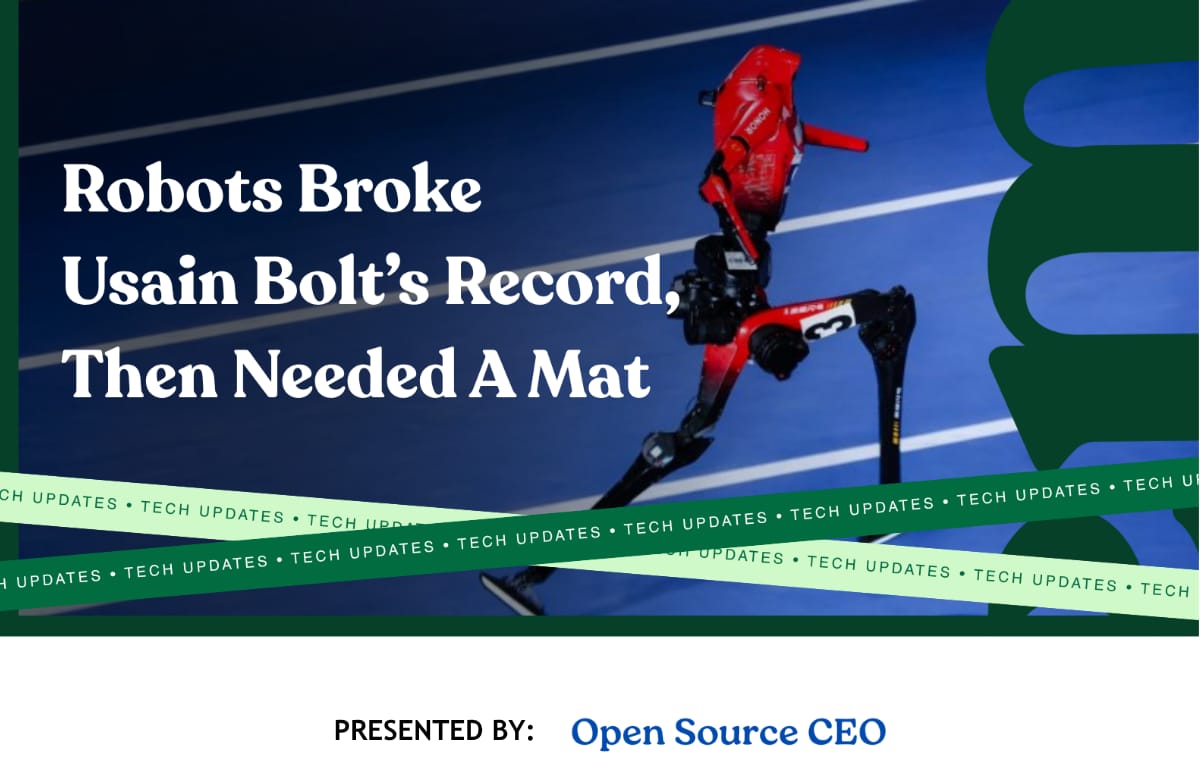
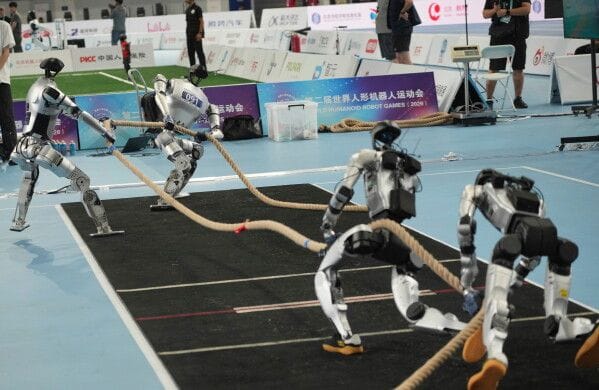
This week, the National Speed Skating Oval in Beijing was filled with 2,056 humanoid robots from 666 teams, competing across 51 events at the second World Humanoid Robot Games. Some of them ran. Some of them fell over. One of them caught fire.
The headline number was hard to argue with. A machine covered 100 meters in 9.39 seconds, and a robot from smartphone maker Honor had already clocked 9.32 seconds in a preparatory test. Usain Bolt's world record is 9.58 seconds, set in Berlin in 2009 and untouched since.
Three days before the opening ceremony, Unitree, listed in Shanghai, closed up roughly 460%. State media called it a breakthrough week. But the most revealing document of the Games was not the results sheet, and it was published weeks before anyone lined up on the track.
Goodies delivered straight into your inbox.
Finance Experts For AI Training.
Training AI on finance requires experts who can evaluate models on valuation, portfolio theory, and risk modeling—not just general annotators.
Athyna Intelligence delivers financial analysts, economists, and quant researchers from Latin America for RLHF, evals, and reasoning tasks.
Same US time zone. Vetted in days. 40–60% savings.
The exam everyone passes and then forgets
The examiner sits beside you with a clipboard and marks a small number of maneuvers on a route the driving school has run a hundred times before. You do the mirror checks, the hill start, and the three-point turn on roads that somebody else picked. Everyone who has passed remembers how little that morning resembled the driving that came after it, on an unfamiliar street where a child steps out from between two parked cars. A test measures maneuvers because maneuvers can be measured on a fixed route in 40 minutes, while the judgment it stands in for cannot be.
Beijing has spent this week running the humanoid version of that test, and the results have been read the way a driving school reads its pass rate. The second World Humanoid Robot Games opened on August 22, 2026, at the National Speed Skating Oval, the arena built for the 2022 Winter Olympics. Reuters reported that the program runs to 51 events, 30 of them modeled on human sport and 21 built around work such as factory assembly, hotel service, and household chores. Sixteen countries sent teams, although an analysis of the registration data found that roughly 96% of the machines came from Chinese entrants. A lopsided field is a domestic industry inspecting itself in public, and the inspection's most repeated finding came from the shortest event on the program.
A record that measures one straight line
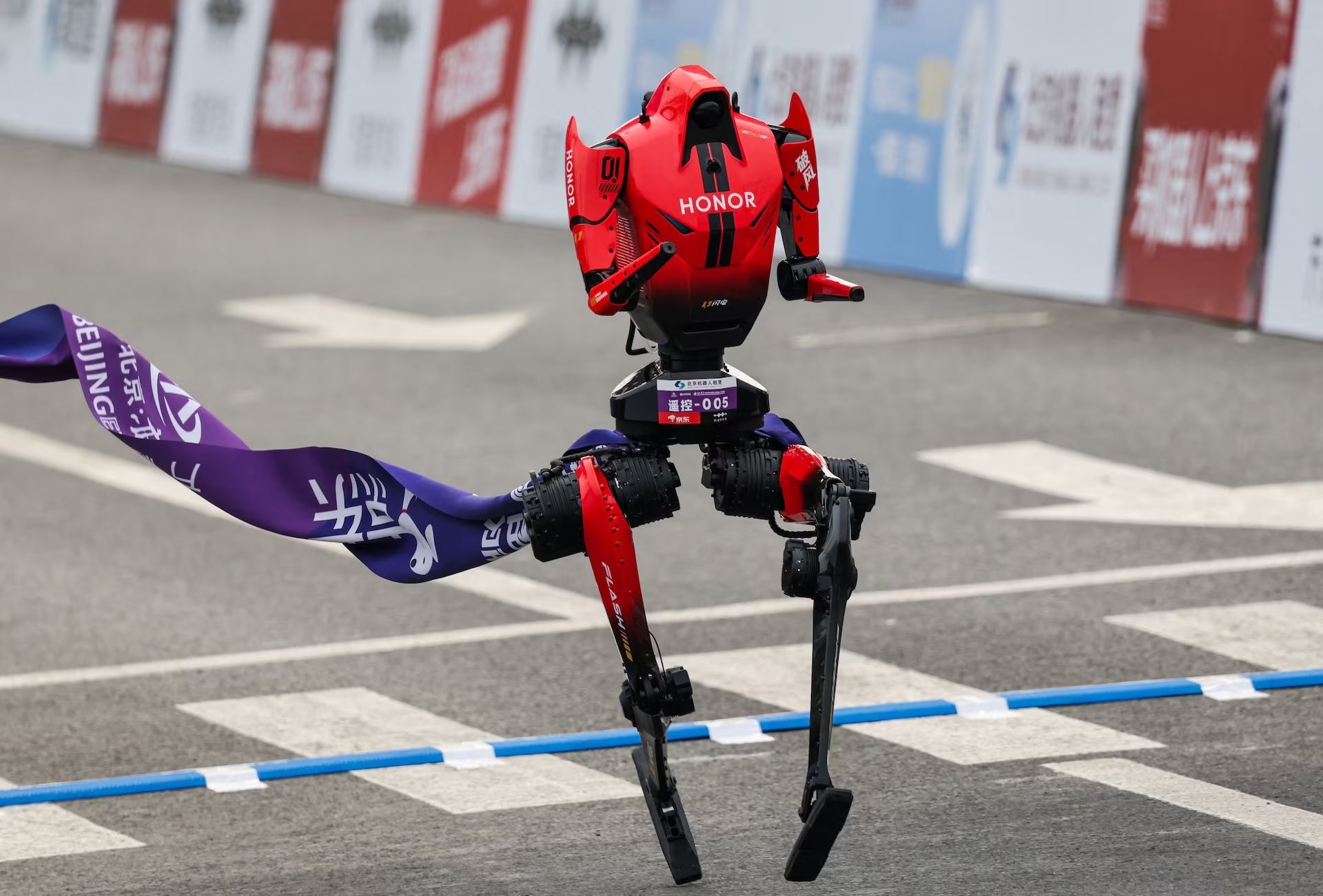
The 100 meters delivered the image that traveled around the world, with two machines covering the distance faster than any human ever has. A robot called Lightning, built by the smartphone maker Honor, ran it in 9.32 seconds, against the 9.58 seconds Usain Bolt ran in Berlin in 2009. Lightning's time came in a preparatory test rather than the competition, where a machine from the Beijing Humanoid Robot Innovation Center ran 9.39 seconds. Both runs are real, and both come from machines designed for a single task: to run on a flat, clean surface.
The shaping is worth describing because Lightning's engineers lengthened its legs by 10 centimeters before the Games, bringing them to 1.05 meters. A longer leg covers more ground per stride, and no human sprinter has ever had that option in the week before a race.
Stopping, however, proved harder than starting, since organizers laid a thick mat several meters past the finish line because the machines could not brake reliably. Somebody at that arena had to watch a robot at full speed and decide where the crash padding should go. One machine caught fire after finishing a heat on the opening day, and staff were photographed by Reuters and Getty wiping the floor around it.
That is the difference between completing a maneuver and being ready for the road. The first thing a driving examiner checks is whether the car can stop, which is the part of the course these Games have not reached. Which parts get tested and which are quietly handed to a human operator was settled months ago in the program the organizers published.
The schedule says what the scoreboard cannot
The event list divides the week into two kinds of tasks. That split explains why the sprint looks much more impressive than the other events. But first, two terms need explaining because the robots can look almost identical on video. Autonomy means the robot perceives its surroundings, decides what to do, and acts on its own. Teleoperation means a person controls the robot remotely in real time, much like flying a drone. The difference matters more to a buyer than a race result: one robot can be given a job and left to do it, while the other still needs a human controlling it.
Huawei, a technology partner of the Games, told Reuters that more than 40% of events require full autonomy, which means close to 60% do not. Flat-ground running, soccer, and table tennis all require the machine to work alone, while hurdles, weightlifting, and kickboxing permit a hand on the controls. Balanced running on a smooth floor has become ordinary enough to take for granted, while obstacles at speed and contact with an opponent plainly have not.
In the 21 work events, a team that uses a remote operator has its score halved rather than being disqualified. Halving is a price rather than a prohibition, and the organizers set it because a prohibition would have left those events nearly empty. What the program leaves out is the other half of the disclosure, since nothing on the schedule involves stairs, uneven ground, or a full shift on one battery charge.
No event measures cost per task or the average hours between failures, which are among the few numbers a factory buyer asks about. Those numbers are being set elsewhere, in the quotes customers receive for a machine and for the person who arrives with it.
The gap now has a daily rate
Those missing numbers point to a larger problem. The event can measure how fast a robot runs and whether it can complete a task, but it says little about what it takes to make the machine useful in the real world. The commercial market is already answering that question in a much simpler unit: the daily cost of sending a robot to do a job.
AGIBOT, one of China's largest makers, runs a service that CNN reported starts at about 3,500 yuan a day, roughly $517. The daily rate covers shipping and a human operator who helps control and program the machine, so what turns up is a robot and a person. More than 5,500 orders came through in the first three months, making this the largest visible commercial use of Chinese humanoids, where the machine is not working alone.
The customers paying those daily rates describe the product without much decoration. A livestreamer in Hangzhou bought a machine for $30k and rents it out for events, giving him a closer view than most buyers get. He told CNN that today's robots cannot work on their own, and that what he owns amounts to an oversized toy. Unitree's own listing documents point in the same direction, showing research and educational institutions buying most of what it sells, with industrial work accounting for under 10% of sales in the first three quarters of 2025. Corporate tours made up more than half of even that industrial share, which makes those particular robots a marketing purchase rather than a labor one. Buyers spending from a marketing budget were not the only people paying for the finished version of these machines, but rather the one that exists.
Stay ahead of AI at work.
Cut through the hype. Roko’s Basilisk distills the day’s AI breakthroughs, market moves, and workable workflows into a five-minute brief.
Get one sharp deep dive, fast Quick Hits, and a witty pro tip, plus links that actually matter.
*This is sponsored content
The share price is buying the finished machine
Investors made the same bet at a much larger scale three days before the Games opened. Unitree was listed on the Shanghai Stock Exchange's STAR Market on August 19, 2026, and the shares closed up more than 460% on the first day. That valued the company at roughly $66B, more than Baidu or JD.com, on a business whose industrial customers are mostly still taking tours. Unitree is growing and profitable, though the offer price alone was already more than 200 times the previous year's earnings.
Behind the private money sits the state, since Beijing launched a national push in June 2026 to place humanoids in more than 100 'high-value application scenarios' by the end of the year. Jiang Guangzhi, a Beijing municipal industry official and a deputy executive director of the Games, has described the intended sequence as machines mastering these last-meter skills and turning medals into orders. The 21 work events exist to begin that conversion, because competition rules harden into technical standards, and standards end up inside procurement lists. Buyers in other countries were watching the same demonstration, and one government has already decided what to do about what it saw.
Washington's answer runs into its own supply chain
Washington moved on July 28, 2026, with a rule rather than a program of its own. The U.S. Federal Communications Commission added foreign-made humanoid and four-legged robots to its list of equipment barred on national security grounds, citing cybersecurity and supply chain risk. The measure is narrower than the headlines suggested, since it covers new models seeking approval rather than machines already authorized or already owned. A gate on tomorrow's products still does the work over time, because the useful robots are the ones nobody has built yet.
The dependency runs in both directions, which Tesla discovered when export controls on rare earth magnets disrupted its Optimus program in 2025. Those magnets sit inside the motors that move a robot's joints, and Elon Musk said at the time that Beijing wanted assurances they would not be used militarily. Each side is now restricting the other while still buying from it, and two governments rearranging themselves around machines, this unfinished, is itself an argument that the skeptical reading is incomplete.
The case for the machines arriving sooner
However, while the week's evidence supports caution, the argument for speed rests on the year-on-year numbers inside the Games themselves. Last year's winning 100-meter time was 21.50 seconds, and the best humanoid high jump was 0.95 meters, compared with 9.39 seconds and 2.88 meters twelve months later. Improvement on that scale is not a marketing artifact because the same events were run the second time under tighter rules. The sprint now mandates autonomy, and the soccer has moved from what organizers called preschool level toward something closer to youth play.
Even the rental business, which may read as an admission of weakness, doubles as a way to collect what these companies most need. Every hire puts a robot into an unpredictable room, and each correction the operator makes becomes an example the next model can learn from. Driver-assistance systems improved along that exact path, learning most from the moments when a person reached over and took the wheel back.
The strongest objection to the whole enterprise is that the human shape may not suit warehouse work, where wheeled bases with arms cost less and use less power. Some machines already entered in the scenario events are built that way, humanoid above the waist and wheeled below it. Settling the argument between the two readings requires a measurement that no one has published, and the week is nearly over.
What the medal table will not say
The Games close on August 26, and the results sheet will say almost nothing about whether these machines can hold a job. What the week establishes is that physical capability is improving quickly on defined tasks, and it does not establish that any humanoid can finish an unsupervised shift. The number worth waiting for is how many of the 21 work events were completed at the full autonomy score rather than the halved teleoperation score.
Organizers have not committed to publishing that breakdown, and the choice they make will be more informative than any sprint time on the board. The mat is still lying several meters past the finish line, in the part of the course where an examiner would begin paying attention.
P.S. Want to collaborate?
Share today’s news with someone who would dig it. It really helps us to grow.
Let’s partner up. Looking for some ad inventory? Cool, we’ve got some.
Deeper integrations. If it’s some longer-form storytelling you are after, reply to this email, and we can get the ball rolling.
What did you think of today's memo? |
|






.svg)
.svg)