Welcome to Memorandum Deep Dives. In this series, we go beyond the headlines to examine the decisions shaping our digital future. 🗞️
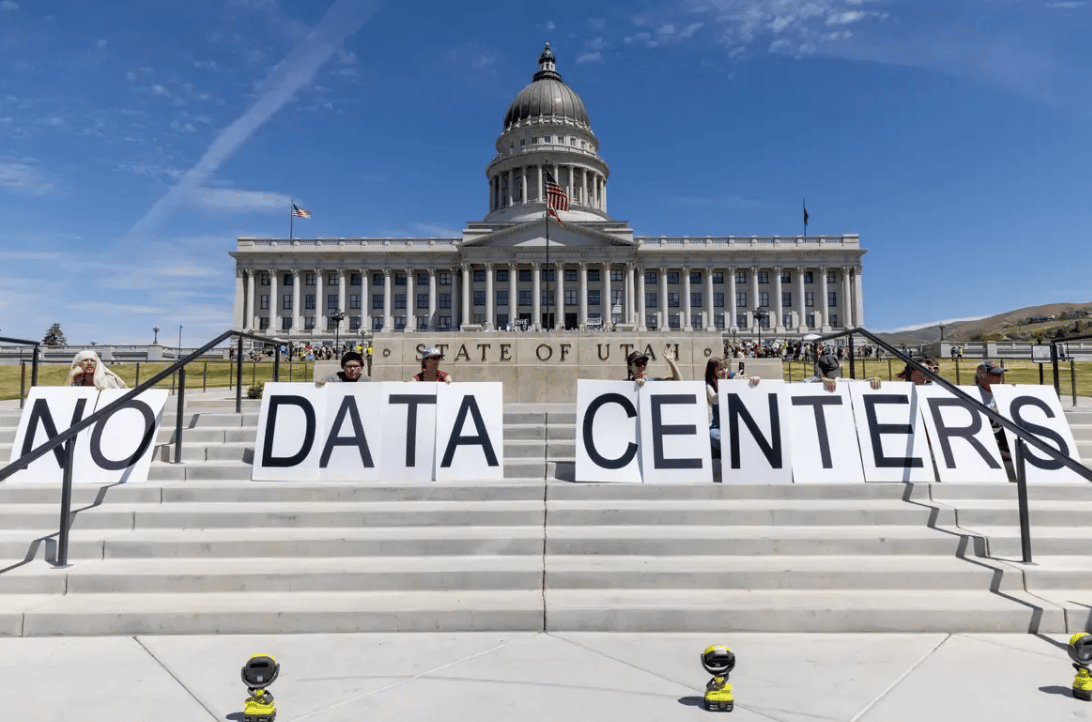
This week, we examine the political moment around artificial intelligence, starting with Utah Governor Spencer Cox's May 29 reversal at a wildlife center near the Great Salt Lake. A month after dismissing residents' concerns about a Box Elder County data center as "really bad information," Cox signed an executive order setting a higher bar for future projects and acknowledged that public pressure had shaped his decision.
Cox is a Republican in one of the most reliably Republican states in the country, signing a restriction on data center growth at a time when the Trump administration is pushing AI infrastructure as a national priority. Washington did not anticipate that alignment, but it is showing up in poll numbers, local zoning fights, and a growing list of recent election results.
What is happening in Utah is one local chapter of a broader shift in how Americans encounter AI. It used to be an abstract debate about safety and regulation; now it shows up in electricity bills, water use, land-use disputes, and the job market. What each party does with that, and how it lands in the 2026 midterms, is the part of the story neither side has worked out yet.
In partnership with

Help make better ads
Did you recently see an ad for Roku Ads Manager in a newsletter? We’re running a short brand lift survey to understand what’s actually breaking through (and what’s not).
It takes about 20 seconds, the questions are super easy, and your feedback directly helps us improve how we show up in the newsletters you read and love.
If you’ve got a few moments, we’d really appreciate your insight.
How Artificial Intelligence Became a Political Liability
On May 29, 2026, Spencer Cox, the Republican governor of Utah, stood at a wildlife center near the Great Salt Lake and publicly reversed course. Just a month earlier, he had dismissed concerns from residents opposing a massive data center project in Box Elder County, telling reporters that “a lot of really bad information was circulating and that the state had an obligation to allow the development to move forward”. Now, he was signing an Executive Order that his office described as establishing a higher bar for future data center projects by requiring state agencies to consider factors such as water availability, air quality, and impacts on electricity costs before granting approvals.
Cox acknowledged that the order came in response to public pressure and reflected concerns raised by residents that his administration had not fully accounted for. Cox’s reversal was striking not only for its speed but also for occurring in one of the most reliably Republican states in the country, at a time when the Trump administration has been actively championing data center construction as a matter of national economic and technological policy. The reversal also reflects the opposition from residents whose concerns about water use, electricity demand, and local impacts cut across familiar partisan lines.
What is happening in Utah reflects a broader shift in how Americans are experiencing artificial intelligence. For some, AI appears as a labor issue, raising fears about job security and shrinking opportunities for new entrants to the workforce. For others, it arrives as an infrastructure issue, requiring vast new data centers that consume land, water, and electricity. Increasingly, voters are encountering both at once, turning AI from an abstract debate about innovation into a tangible political issue rooted in economic and community concerns rather than traditional ideological divides.
An unease that does not sort
For most of the past decade, worry about AI ran along predictable lines, with Democrats focused on bias and social harm and Republicans on regulation and federal overreach. However, as AI advances towards greater real-world consequences and infrastructure development consumes electricity and water, that divide has largely dissolved. According to a May 2026 Economist and YouGov poll, 71% of Americans now believe AI is developing too fast, a figure that includes 77% of Democrats and 68% of Republicans, and twice as many respondents call themselves pessimists about the technology as optimists. The gap between the parties, once the entire story, has narrowed to nine points.
That convergence is now visible on the ground, with more and more communities moving either to stop new data center construction or to protest ongoing projects.
According to Data Center Watch, a tracking project run by the AI research firm 10a Labs, at least $64B in data center projects were blocked or delayed by local opposition between 2023 and early 2025, with an estimated $98B more stalled during a single quarter of last year. Its analysts describe the resistance as “cross-partisan and geographically mixed.” Conservative landowners worried about water, progressive activists worried about emissions, and suburban homeowners worried about their property values dropping, which is what makes it so hard for either party to absorb.
What the votes already show
The question that follows is whether a feeling this widely shared can move an election, and the early answer is that it already has.
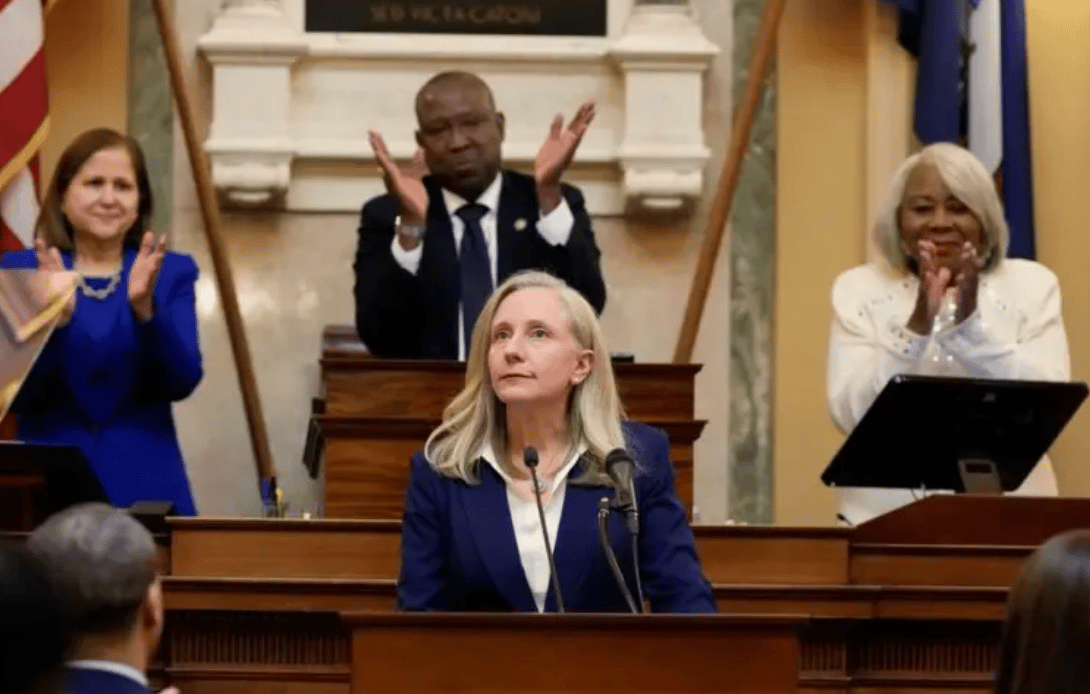
In Virginia, home to the world’s largest concentration of data centers, Abigail Spanberger won the governorship last November after building her campaign around affordability, including a pledge to make the industry pay its fair share of rising electricity costs. In neighboring New Jersey, Mikie Sherrill won after promising to freeze electricity rates on her first day in office, having complained during a campaign debate that Virginia’s data centers were “sucking all the power out of our market.”
In Georgia, two Democrats captured seats on the commission that regulates utilities, ending the commission’s all-Republican makeup, tying the state's rising electricity prices to data center growth.
What these elections have revealed is that discontent is sharpest among those about to enter the workforce. A Gallup survey of more than 1,500 Americans aged 14 to 29, conducted in early 2026, found a notable deterioration in attitudes toward AI. The share of respondents who said they felt hopeful about the technology fell to 18%, down from 27% a year earlier, while the proportion expressing anger rose to 31%, up from 22%. Gallup researcher Zach Hrynowski attributed much of that frustration to a specific concern: the perception among students and recent graduates that they invested years of study and significant financial resources preparing for careers that are now being reshaped before they have a chance to enter them.
Labor market data suggest those anxieties are not entirely abstract. According to Stanford’s Digital Economy Lab, workers aged 22 to 25 in occupations with high exposure to AI, including software development and customer service, have experienced a 13% relative decline in employment since generative AI entered the mainstream in 2022, even as overall employment levels continued to rise. Together, the figures help explain why what was initially framed as a technological breakthrough is increasingly being viewed by many young people through the lens of economic uncertainty.
An issue neither side can own
This uncertainty has increasingly given way to anger, and while that anger has begun to generate electoral momentum, transforming it into a durable political force is a far more complicated challenge. The issue resists easy partisan ownership as concerns about AI-driven job displacement, rising electricity demand, data center expansion, and the concentration of technological power cut across traditional ideological lines, drawing support from constituencies that do not fit neatly within either party’s coalition.
The Democratic position remains divided between its populist and pro-growth factions. In Pennsylvania, Governor Josh Shapiro has welcomed Amazon’s $20B data center investment, while in Maine, Governor Janet Mills vetoed what would have been the nation’s first statewide moratorium on large data centers, arguing that concerns were valid but refusing to block a $550M project in Jay. An effort to override her veto narrowly failed, underscoring how opposition to data centers cuts across party lines rather than following a clear partisan divide.
The Republican position is no more settled. While the Trump administration has pushed for a rapid expansion of AI infrastructure and sought to limit state-level restrictions, some of the strongest opposition has come from Republican voters in states such as Utah. The political battle is similarly cross-partisan. Leading the Future, a pro-AI super PAC backed by investors including Andreessen Horowitz and OpenAI co-founder Greg Brockman, has raised over $100M for the 2026 cycle and is supporting candidates from both parties.
On the other side, Senator Bernie Sanders and Representative Alexandria Ocasio-Cortez have proposed a moratorium on new AI data centers until federal safeguards are enacted. Although the measure is unlikely to pass, it offers a ready-made platform for candidates seeking to channel growing public unease about AI.
Outperform the competition.
Tools & resources, ranging from playbooks, databases, courses, and more.
Deep dives on famous visionary leaders.
Interviews with entrepreneurs and playbook breakdowns.
*This is sponsored content
Where it gets measured
To the extent this issue is tested politically, Pennsylvania is one of the places to watch. The state already hosts more than 100 data centers, and Amazon’s latest expansion is concentrated in areas where several competitive House races could help determine control of Congress. As concerns over electricity costs and infrastructure growth spread, incumbents find themselves caught between an administration pushing for rapid AI expansion and constituents increasingly worried about its local consequences.
That tension is visible in Utah as well. Cox did not stop the Box Elder County project, but he did impose stricter standards for future proposals after sustained public pressure. The broader dispute remains unresolved, having shifted from public protests into the slower world of permitting, regulation, and legal challenges.
That, increasingly, is the shape of the AI debate across the United States. Opposition to AI infrastructure is becoming too widespread to ignore, yet it does not fit neatly into either party’s agenda.
Since the start of the AI boom, the political debate has largely been framed around abstract questions: safety, regulation, innovation, and competition with China. What is emerging now is something more tangible. Voters are encountering AI not as a technology but as a physical presence in their communities and a force in their economic lives, showing up in electricity bills, water consumption, land-use battles, and anxieties about career prospects. Those concerns do not map neatly onto the coalitions that have defined American politics for the past decade, which is why neither party has managed to fully claim the issue.
The 2026 midterms may offer the first indication of whether AI is becoming a genuine voting issue or merely another source of public frustration. Either way, Spencer Cox’s reversal in Utah suggests that the politics of artificial intelligence is no longer being shaped solely in Washington or Silicon Valley. Increasingly, it is being shaped in the communities asked to accommodate its costs.
P.S. Want to collaborate?
Share today’s news with someone who would dig it. It really helps us to grow.
Let’s partner up. Looking for some ad inventory? Cool, we’ve got some.
Deeper integrations. If it’s some longer-form storytelling you are after, reply to this email, and we can get the ball rolling.
What did you think of today's memo? |
|





.svg)
.svg)