Welcome to Memorandum Deep Dives. In this series, we go beyond the headlines to examine the decisions shaping our digital future. 🗞️
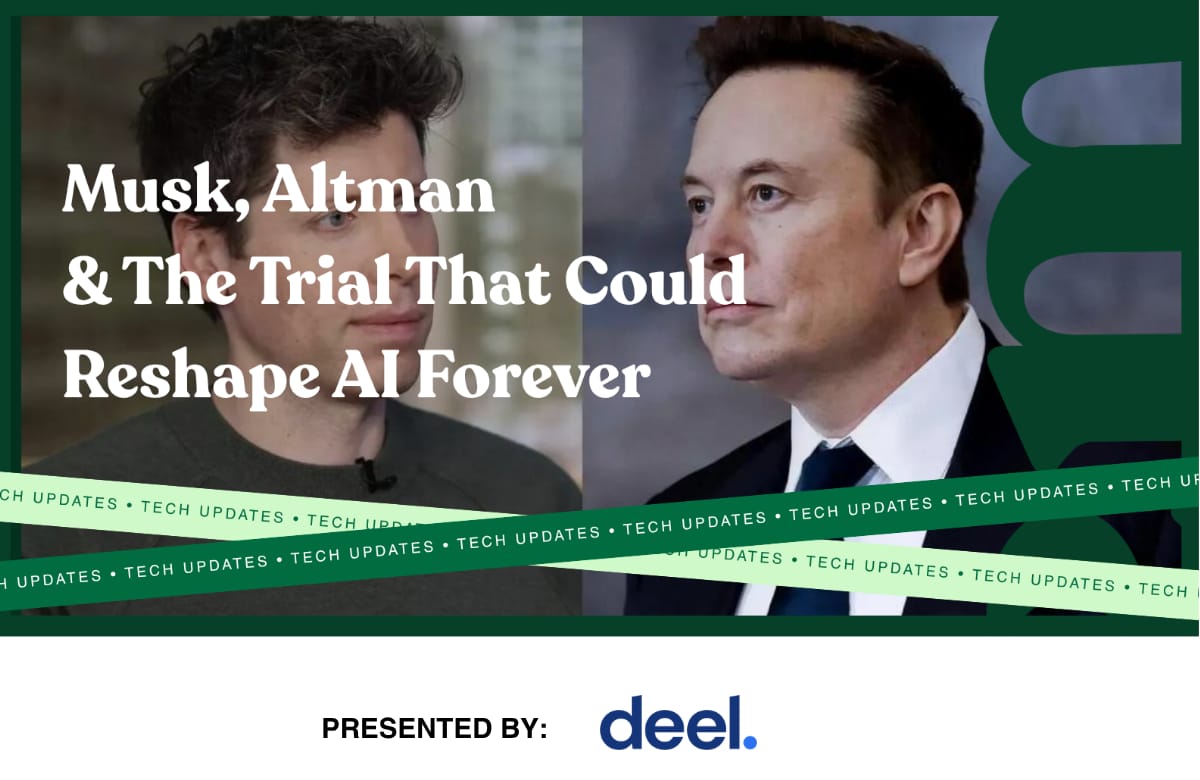
This week, the AI industry's most consequential legal dispute heads to court, and the outcome could reshape how the world's most powerful technology companies are structured, funded, and held accountable. What began as a public feud between two of Silicon Valley's most prominent figures has quietly evolved into something far more substantive: a formal test of whether a nonprofit's founding promises carry legal weight once billions of dollars are at stake.
The case centers on OpenAI, the company behind ChatGPT, which transitioned from a nonprofit research lab to a for-profit enterprise, a shift that its co-founder Elon Musk argues was not just opportunistic, but fraudulent. Musk, who donated approximately $38M to the organization in its early years, claims he was deliberately misled about the company's long-term structure and that the people who made those assurances privately knew they would not honor them.
At its core, though, this trial is not really about Elon Musk or Sam Altman. It is about a structural tension that has been building across the AI industry for years. One that no product launch, funding round, or regulatory filing has yet resolved. A jury of ordinary citizens in Oakland, California, is now being asked to settle it.
In partnership with

Hiring in 8 countries shouldn't require 8 different processes
This guide from Deel breaks down how to build one global hiring system. You’ll learn about assessment frameworks that scale, how to do headcount planning across regions, and even intake processes that work everywhere. As HR pros know, hiring in one country is hard enough. So let this free global hiring guide give you the tools you need to avoid global hiring headaches.
A fraud case dressed up as a rivalry
Nothing makes an industry as compelling to watch as a genuine rivalry between companies trying to outdo each other. The soft drink industry has long been defined by Pepsi versus Coca-Cola, the automotive world by Ford versus Ferrari, and social media by Instagram versus TikTok. These rivalries do more than create spectacle; they force companies to push harder, iterate faster, and ultimately deliver better products to users.
The world of AI is no different in its competitive intensity, but the way that rivalry is unfolding is markedly different. Instead of playing out through advertising wars or feature launches, it is increasingly being fought in courtrooms and policy arenas, where the stakes extend far beyond individual products. What is being contested is not just market leadership, but the very structure and direction of the AI industry itself.
On April 27, a jury in Oakland, California, will begin hearing a case that has less to do with two billionaires feuding and more to do with a structural question the AI industry has been deferring for years: can an organization promise to build the most consequential technology in history for the benefit of humanity, convert that promise into hundreds of billions of dollars in private value, and face no legal consequences for the pivot?
The case is Musk v. Altman, in which Elon Musk, who co-founded OpenAI in 2015 and contributed approximately $38M to the nonprofit, alleges that Sam Altman and Greg Brockman fraudulently assured him that the organization would remain a nonprofit while privately planning to convert it into a for-profit enterprise. Musk is seeking up to $134B in damages from OpenAI and Microsoft, the removal of Altman and Brockman from their leadership roles, and the unwinding of OpenAI’s corporate restructuring. In this legal battle, Microsoft is named as a co-defendant in claims alleging it aided and abetted a breach of fiduciary duty.
Internal documents, including Brockman’s diary entries and contemporaneous communications, suggested early doubts about the shift to a for-profit model. At the same time, messages involving Microsoft indicated awareness of potential issues around donor intent. Together, the findings were sufficient for the court to allow the claims, including those against Microsoft, to proceed to trial.
What the jury actually has to decide
In this legal battle, the legal question is narrower than the headlines suggest. The jury is not deciding whether OpenAI should be nonprofit or for-profit, but whether Sam Altman and Greg Brockman made specific promises to Elon Musk about staying nonprofit that they knew were false, and whether Musk relied on those promises when he donated.
That distinction matters because it frames the evidentiary burden. Musk’s team needs to convince a jury of non-tech civilians that the Brockman diary entries, the Altman emails, and the Microsoft communications add up to a pattern of intentional deception rather than the messy reality of a startup finding its footing.
Meanwhile, OpenAI’s defense is that the for-profit subsidiary was announced publicly in 2019, that Musk continued donating through September 2020, and that the Brockman diary entries have been taken out of context. The company argues Brockman was processing internal anxieties, not making confessions.
The jury must also decide damages, though that question is more complex. Elon Musk’s expert, C. Paul Wazzan, argued that Musk’s contributions accounted for more than half of OpenAI’s early value and applied that share to its current $852B valuation. Yvonne Gonzalez Rogers has expressed skepticism about this approach, suggesting the figure lacked a clear basis. The claim is unusual because nonprofit donations do not typically translate into equity-like stakes, and treating Musk’s $38M contribution as potentially worth over $134B would set a new legal precedent. On April 7, Musk amended his filing to direct any damages to OpenAI’s nonprofit foundation rather than himself, addressing optics without changing the core legal argument.
Then there is the competitor problem. Elon Musk’s xAI submitted an unsolicited $97.4B bid to acquire OpenAI, and court filings unsealed on March 31 revealed that Musk had privately approached Mark Zuckerberg to join the bid, which Zuckerberg declined. The overlap between litigation and competition has only deepened since, with SpaceX acquiring xAI in a $1.25T deal in February 2026 and subsequently filing confidentially for an IPO targeting a $1.75T valuation, raising further questions about the extent to which the lawsuit intersects with Musk’s broader competitive ambitions in AI.
Outperform the competition.
Tools & resources, ranging from playbooks, databases, courses, and more.
Deep dives on famous visionary leaders.
Interviews with entrepreneurs and playbook breakdowns.
*This is sponsored content
The competitor problem
OpenAI, at its end, has also not been a passive observer. On April 6, the company sent letters to the attorneys general of California and Delaware, urging an investigation into Musk’s ‘anti-competitive behavior’ and alleging coordination with Zuckerberg. The letters referenced a New Yorker investigation published on April 7 that reported that Musk’s intermediaries conducted extensive opposition research on Altman, including tracking his flights and pursuing unsubstantiated personal misconduct allegations.
That same New Yorker piece also surfaced allegations from former OpenAI chief scientist Ilya Sutskever’s internal memos, which described a “consistent pattern of lying” by Altman, and notes from Anthropic co-founder Dario Amodei documenting instances in which safety commitments were overridden by commercial deals. The pre-trial information environment is, in short, chaotic and adversarial on every side.
The trial, though, aims to shed some clarity on this mess and will also have immediate consequences that can reverberate across the industry.
Why the outcome matters beyond the courtroom
Its most immediate impact is on OpenAI’s IPO plans. The company recently raised funds at a $852B valuation and is generating about $2B in monthly revenue, with Sam Altman pushing for a late 2026 listing despite internal concerns about the timeline.
Even a partial adverse ruling could complicate that path by forcing disclosures, dampening investor demand, or requiring structural changes, potentially pushing capital toward rivals like Anthropic, which is also considering an IPO.
The longer-term impact is structural, extending beyond OpenAI to the broader AI industry, where many mission-driven organizations have followed a similar path of eventually commercializing. A ruling against the company could make that transition much harder by increasing regulatory scrutiny and giving donors more power to challenge such changes. At the same time, a win for Elon Musk would strengthen xAI, without resolving the core tension between building safe AI and building profitable AI; it would only decide who sets the terms.
What this does not settle
The request to remove Sam Altman and Greg Brockman and unwind OpenAI’s for-profit shift is likely unrealistic, since courts rarely order structural changes to companies of this scale, especially when regulators in California and Delaware had already approved the transition. A more plausible outcome would be financial damages in the single-digit billions—enough to complicate an IPO, but not threaten the company’s survival.
A settlement is still possible, though both sides have escalated so far, and even a verdict would likely be followed by appeals. What the trial cannot resolve is the larger question it raises: whether the corporate structures governing AI are suited to its stakes. OpenAI’s transition received regulatory approval and investor backing, but whether it met the expectations of its original donors will now be decided by a jury parsing internal records to determine whether this was standard practice or something more serious.
P.S. Want to collaborate?
Share today’s news with someone who would dig it. It really helps us to grow.
Let’s partner up. Looking for some ad inventory? Cool, we’ve got some.
Deeper integrations. If it’s longer-form storytelling you are after, reply to this email, and we can get the ball rolling.
What did you think of today's memo? |
|





.svg)
.svg)