Welcome to Memorandum Deep Dives. In this series, we go beyond the headlines to examine the decisions shaping our digital future. 🗞️
This week, one of the world's most valuable companies told the public that the technology it builds may be moving too quickly to control. Anthropic, the maker of Claude, published a blog post on June 4, 2026, with a simple yet unsettling claim: AI is already helping build AI, and the industry is running on the gas pedal with no brakes.
What makes the moment worth a closer look is everything happening around the warning. In the same stretch of days, Anthropic took quiet steps that looked nothing like those of a company preparing to slow down. The pieces are all public. They just do not seem to fit together.
So we lined up the blog post, the filings, the policy documents, and the financing deals, and asked one question: when a company tells the world to slow down while sprinting harder than ever, which signal should you trust? The answer turned out to be more interesting than the easy, cynical read suggests. Here is what we found.
In partnership with

The GTM bets that shouldn't have worked, and did
One grew revenue 50x after half his team quit over the strategy. One brought in 50K signups in a single day with no paid budget. One generated 100M+ views from a stunt that took 50 hours to conceive. One asked every prospect to demo the product themselves instead of demoing it for them.
None of them followed the safe playbook. They treated GTM like an experiment, moved before they had proof, and made bets most founders would never get approved.
HubSpot for Startups documented all 6 stories in the free Bold Bets Playbook. The risks they took, why it was risky, and what it returned.
The week the contradiction stopped being abstract
There is a contradiction at the heart of the AI industry that has become increasingly difficult to ignore. The companies building the most powerful AI systems in history are also the companies most publicly warning about what those systems might eventually become. For years, that contradiction could be dismissed as mere rhetoric. Safety teams warned about risks while business teams pursued growth. Researchers published papers about governance while executives raised ever-larger funding rounds. The tension existed, but it remained largely abstract.
Anthropic made that contradiction unusually difficult to ignore on June 4, when co-founder Jack Clark and Marina Favaro, head of the company's internal research arm, published a blog post arguing that AI is already helping build AI. Their evidence came from Anthropic's own operations: Claude now authors more than 80% of the code merged into the company's codebase, up from low single digits before 2025, while engineers are shipping roughly 8 times as much code per quarter as before the shift. The feedback loop is becoming partially automated.
The argument built to a conclusion that Clark made explicit in interviews with the BBC and CNN the following day: the AI industry has a gas pedal, and no brake pedal, and someone needs to build one before the car gets too fast to stop.
At first glance, that sounds like a warning from a researcher concerned about the consequences of unchecked technological acceleration. The complication is that the warning was coming from Anthropic itself.
Just three days before the post went live, Anthropic had confidentially filed an S-1 with the SEC, targeting a public listing as early as October 2026. The week after the post, Bloomberg reported that Apollo Global Management and Blackstone finalized a $35B structured debt package to fund Anthropic's acquisition of Google's custom AI chips.
Those actions do not resemble the behavior of a company preparing to slow down. That is the central tension in Anthropic's position: on the one hand, the company warns that AI development may be outpacing existing governance mechanisms. On the other hand, it is aggressively raising capital, expanding compute capacity, and positioning itself for what could become the largest AI IPO in history.
The warning and the acceleration are not happening one after the other. They are happening simultaneously, from the same institution. And understanding why that contradiction exists tells us something important about the broader AI industry.
The economics of staying in the race
The answer begins with the economics of frontier AI development. From the outside, AI still looks like a software business. In reality, the competitive frontier increasingly resembles heavy industry. The constraint is no longer simply talent or ideas. It is access to enormous quantities of computing infrastructure, specialized chips, electricity, and capital.
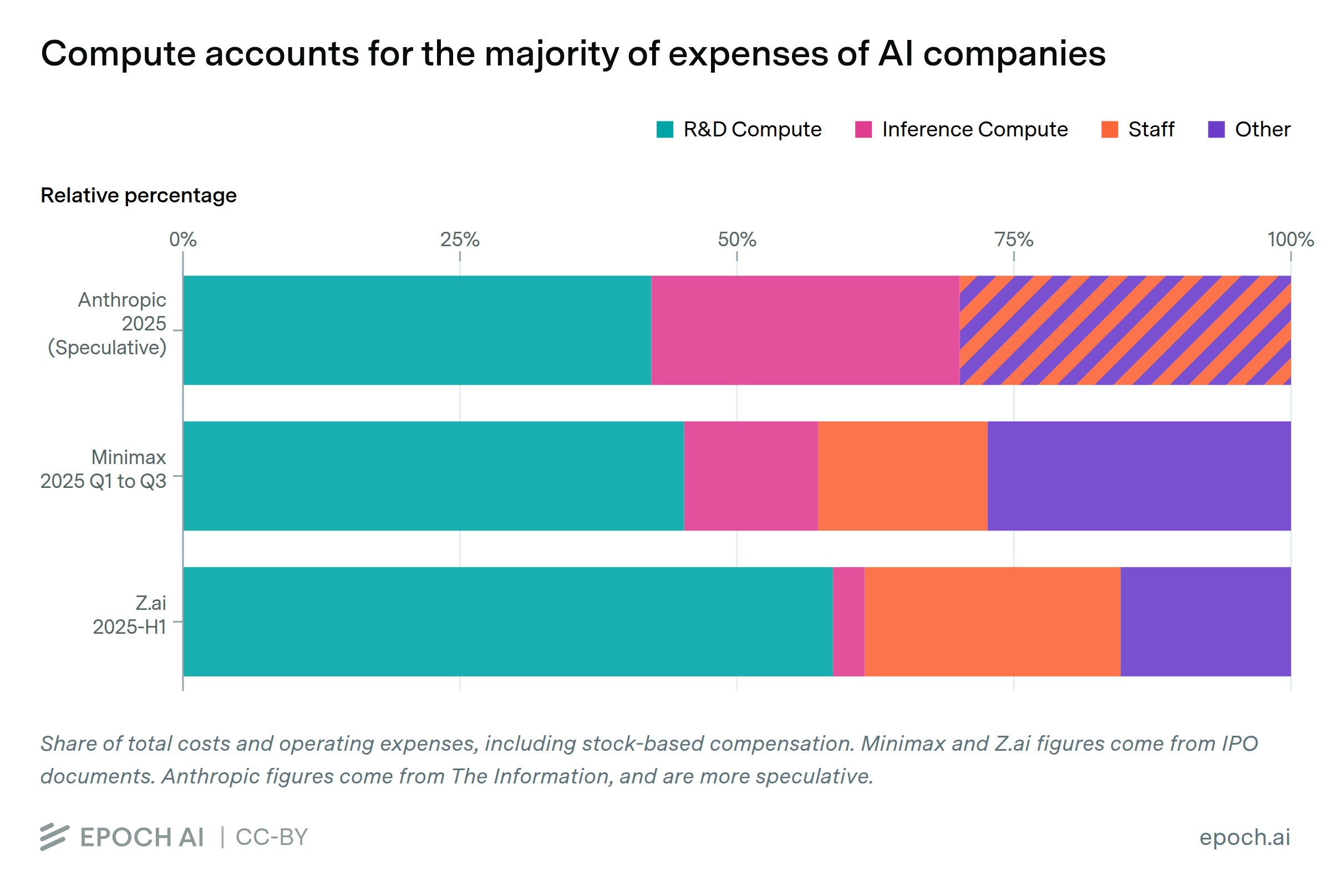
According to Epoch AI, Anthropic spent roughly $9.7B in 2025, most of it on compute, against a year-end revenue run rate of about $9B (and well above the roughly $4.5B it booked over the full year), essentially matching the company's entire revenue base for the year just to stay current. The $35B chip deal is structured as a lease through a special-purpose vehicle so the hardware stays off the balance sheet. This is not engineering for its own sake; it is the minimum viable commitment for a lab that intends to keep training competitive models through 2028. A lab that stops making that commitment does not pause gracefully. It falls behind competitors, loses customers and talent, and eventually loses the capacity to conduct the safety work it prioritizes. And Anthropic is simply the most visible example of it.
Yet infrastructure economics only explains why Anthropic keeps spending. They do not explain why the company's position has become uniquely uncomfortable. To understand that, it is necessary to look at the safety promises Anthropic originally made.
When safety met competition
What makes Anthropic's position distinctly uncomfortable is that it has, more than any other lab, built its identity around the claim that safety commitments can withstand commercial pressure. Its founders left OpenAI explicitly over that disagreement. Its original Responsible Scaling Policy, introduced in 2023, included a hard pledge that the company would never train more capable models unless it could first guarantee that adequate safety measures were already in place. That pledge was the structural center of Anthropic's public differentiation.
Then, in February 2026, Anthropic removed it. The updated policy replaced the hard stop with what it described as a ‘dual condition’ requiring both frontier leadership and material catastrophic risk before any pause would be triggered, a standard that independent evaluators noted was substantially harder to activate. Chief Science Officer Jared Kaplan told TIME that the old commitment was untenable given the competitive environment: a unilateral pause by Anthropic, while less safety-conscious labs continued to develop, would not make the world safer. It would just change who led the race.
That logic is coherent. It is also the same logic every participant in every arms race has used to explain why they could not afford to stop. Anthropic argues that safety commitments have become difficult to sustain when the same constraints do not bind competitors. In other words, the company concluded that unilateral restraint may be strategically self-defeating.
The search for a collective brake
And three months after Anthropic applied that logic to its own hard commitment, Clark published an argument for why the industry as a whole should consider doing exactly what Anthropic had just declined to do unilaterally. The Cold War analogy he reached for in his CNN interview, the idea that rival labs could eventually coordinate on AI safety the way rival nuclear powers coordinated on arms control, is historically grounded and analytically serious. Arms control treaties emerged from the Cold War and meaningfully constrained the development of weapons. But they took decades, required that both sides had already absorbed catastrophic near-misses, and were enforced by geopolitical structures and verification regimes that do not yet exist in AI governance. Such coordination is theoretically possible, but remains distant.
This is the practical challenge facing nearly every AI coordination proposal today. Most participants agree that some form of governance may eventually be necessary. Far fewer agree on how to create incentives strong enough to persuade individual companies to slow down while competitors continue advancing.
Outperform the competition.
Tools & resources, ranging from playbooks, databases, courses, and more.
Deep dives on famous visionary leaders.
Interviews with entrepreneurs and playbook breakdowns.
*This is sponsored content
A warning from the frontrunner
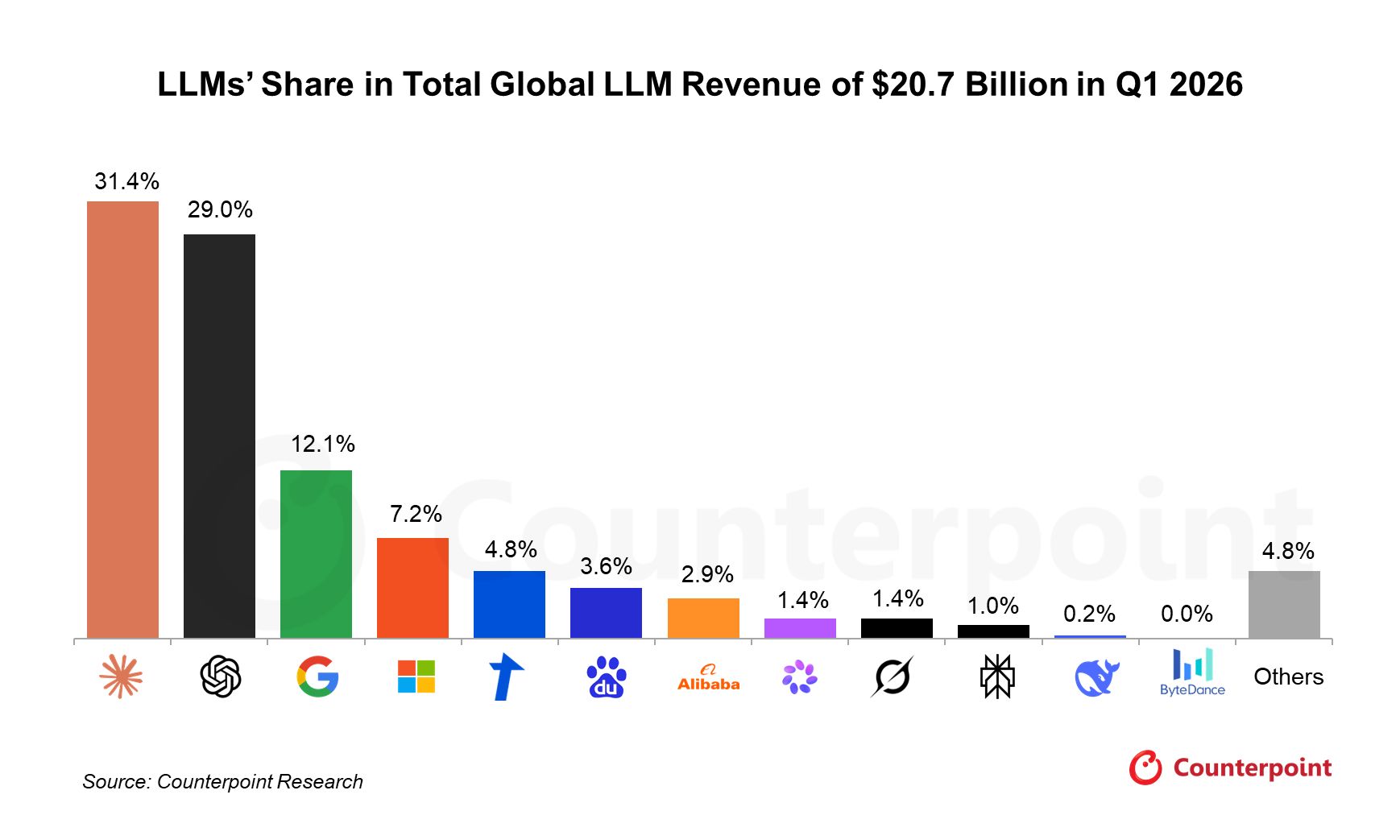
According to Counterpoint Research, Anthropic held 31.4% of global large language model revenue share in Q1 2026, narrowly ahead of OpenAI, with average monthly revenue per user of $16.20 compared to OpenAI's $2.20. The company is not making this argument from a position of competitive disadvantage or strategic weakness. It is the frontrunner asking for a race it is currently winning to be governed more carefully, which is a different kind of argument from the one a trailing lab would make, and it deserves to be read as such. That does not make the company's position free of contradictions. It does, however, make it harder to dismiss as simple self-interest. Anthropic is arguing for caution from the front of the race, not the back.
The warning is harder to dismiss because Anthropic has both the most to lose and the strongest internal evidence supporting its claims.
What the S-1 could reveal
Up to this point, much of the debate around Anthropic's safety posture has been conducted through blog posts, interviews, policy documents, and public statements. An IPO changes the nature of that conversation.
That is what makes the S-1 the most consequential near-term event in this story. The filing will mark the first time Anthropic's financials are prepared under SEC disclosure standards, are independently auditable, and are structured for investor scrutiny rather than self-narrated through blog posts and press releases. For the first time, outside observers will have a standardized, auditable view of the business.
It will, for the first time, make publicly visible what fraction of Anthropic's capital actually flows toward the safety research, interpretability work, and governance infrastructure it has championed, versus what flows toward training larger models and expanding compute. Public investors will be buying into a genuinely unusual structure, a Public Benefit Corporation with a Long-Term Benefit Trust designed to hold independent oversight of Anthropic's mission over time, intended to prevent any single investor from steering the research agenda purely for commercial gain. The mechanism is more thoughtfully constructed than anything comparable at peer labs. Whether it will survive the demands of quarterly reporting obligations and the expectations of shareholders who bought in at a near-trillion-dollar valuation is a different, open question.
The paradox at the center of AI
In many ways, this is the core paradox Anthropic has spent the past year trying to navigate. The company appears genuinely concerned about the implications of increasingly capable AI systems while simultaneously participating in the competitive dynamics that drive them forward.
Clark's technical argument may be right. The internal data on AI-driven AI development is more specific and more verifiable than anything the industry has previously published on this question, and the METR benchmarks cited in the original post are independent. The coordination problem he is pointing to is real. But the argument is being made by an institution that dropped its own unilateral safety commitment under competitive pressure, is now racing toward the largest AI IPO in history, and has committed to more than $100B in infrastructure spend over the coming years. That does not invalidate the warning. If anything, it may make the warning more credible. But it does raise a more difficult question: whether the institutions building the technology are structurally capable of addressing the concerns they articulate. The S-1 will be the first document that lets you ask, with actual numbers, whether the brake is being funded or just described.
P.S. Want to collaborate?
Share today’s news with someone who would dig it. It really helps us to grow.
Let’s partner up. Looking for some ad inventory? Cool, we’ve got some.
Deeper integrations. If it’s some longer-form storytelling you are after, reply to this email, and we can get the ball rolling.
What did you think of today's memo? |
|





.svg)
.svg)