Welcome to Memorandum Deep Dives. In this series, we go beyond the headlines to examine the decisions shaping our digital future. 🗞️
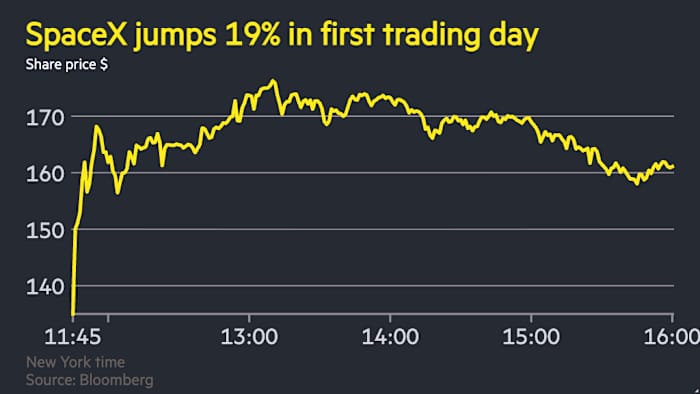
This week, SpaceX did something it had resisted for more than two decades: it went public. On June 12, 2026, a company long considered too costly, too technical, and too tightly held for ordinary investors finally opened its books to anyone with a brokerage account. The order book swelled past $250B in bids, and by the closing bell, the stock had jumped about 19% to $160.95.
The milestone was historic by almost every measure. The largest IPO ever pushed SpaceX beyond a $2T valuation and made Elon Musk the world's first trillionaire. It was pitched as a democratization of access, a rare chance for everyday investors to own a slice of the launch business, the Starlink engine, and the long bet on Mars.
But the prospectus that opened the doors also carried a detail the headlines mostly skipped. Buried in the filing was a decision about how SpaceX would be governed once the public arrived, one that shapes exactly what those new shareholders are buying. Whether they noticed it or not may matter more than the price they paid.
Meet your next hire in as little as five days.
The clause hidden in the filing
On June 12, 2026, after more than two decades operating in a sector once considered too expensive, too technical, and too heavily regulated for private enterprise, SpaceX finally opened its doors to ordinary investors.
The awaited IPO was marketed as a broadening of access to one of the world’s most closely held companies. SpaceX initially set aside as much as 30% of the offering for retail investors, an unusually large allocation for a deal of this size, but overwhelming institutional demand ultimately reduced the retail share to roughly 20%. Even so, individual investors participated at a scale rarely seen in a major listing, helping drive an order book that attracted more than $250B in bids.
The stock priced at $135, opened above $150, and closed its first day of trading up about 19% at $160.95, pushing the company’s valuation beyond $2T and making Elon Musk the world’s first trillionaire. The largest initial public offering in history, by a wide margin, was presented as a democratization of access. Anyone with a brokerage account could now own a piece of Mars. Yet the same prospectus that expanded access made clear that ownership would not come with any meaningful influence over how the company is run.
What the offering quietly locked in
The detail sits in the filing rather than the headlines. After the listing, Musk holds up to 85% of SpaceX's voting power while owning about 42% of the equity, an arrangement based on a multi-class share structure that separates voting power from equity. The shares sold to the public carry economic exposure: they rise and fall with the company. The shares Musk retains carry the votes. In a letter to the company, the comptrollers of New York State and New York City and the head of CalPERS, the largest public pension fund in the United States, spelled out the consequences in plain arithmetic. By their reckoning, any vote to remove the company's most powerful officer would need that officer's support to pass, leaving him effectively impossible to dislodge without his own agreement.
This structure is deliberate, an intended feature of the company's choice to go public. A multi-class structure issues more than one type of common stock, identical in every respect except the number of votes each share commands. Founders keep the high-vote class and sell the low-vote or no-vote class to the public. The founder keeps the steering wheel. The SpaceX offering covered only about 4% of the company's roughly 13.08B shares outstanding, so even as that public float (the slice of shares available for everyday trading) changes hands and the valuation swings, control never moves.
The tension the access story conceals
SpaceX may now be publicly listed, but control remains concentrated, creating a tension that sits at the heart of the story. Public markets were built on a straightforward bargain: investors provide capital in exchange for a claim on future profits and a degree of influence over how a company is governed through votes on directors, mergers, and executive compensation. SpaceX's multi-class structure preserves the economic side of that arrangement while leaving most decision-making authority in Elon Musk's hands. Shareholders can participate in the upside of a company investing heavily in Starship and orbital AI infrastructure despite losing $4.94B in 2025, yet the strategic decisions that determine whether those investments ultimately succeed remain largely beyond their reach.
For a company like SpaceX, the structure is part of the product, and therefore part of what the stock is priced on. Investors are buying Musk's judgment as much as the rockets, and Musk has long argued that the discipline of public markets, the pressure for short-term results, and the legal exposure that comes with it, is precisely what a company chasing Mars should be insulated from. The multi-class arrangement resolves that conflict in his favor. It lets him raise tens of billions from the public while keeping the company running as though it were still private. The shareholders get the upside thesis. They do not get the lever that would let them act on a different one.
There is, however, a reason investors continue to accept these arrangements. SpaceX operates on timelines and capital requirements that sit well outside the rhythms of most public companies. Starship alone represents a decades-long development effort, while the company's broader ambitions encompass satellite infrastructure, launch services, and long-term plans that extend beyond Earth. Many investors view concentrated founder control as a form of strategic continuity, reducing the likelihood that shifting market sentiment or activist pressure will force a company to change course before those bets have had time to mature. For shareholders who believe Musk's vision is central to SpaceX's value, the governance structure can appear less like a restriction and more like part of the investment thesis itself.
Stay ahead of AI at work.
Cut through the hype. Roko’s Basilisk distills the day’s AI breakthroughs, market moves, and workable workflows into a five-minute brief.
Get one sharp deep dive, fast Quick Hits, and a witty pro tip, plus links that actually matter.
*This is sponsored content
Why the market keeps saying yes
The proposition that investors have little to no say in how a company is governed is not new. The modern template was set in March 2017, when Snap sold a class of stock to the public with no voting rights, the first major IPO to offer zero voting rights to new investors.
The posture, however, has since softened, and SpaceX shows how far it has come. The evolution of index rules illustrates how acceptance of founder-controlled structures has spread through the market. Accommodations that once appeared exceptional are now increasingly part of the process by which large technology companies reach major benchmarks. Nasdaq rewrote its rules ahead of the listing to let a company this size join the Nasdaq-100 in as little as 15 trading days, rather than three months, fast-tracking the very kind of low-float, founder-controlled stock that drew objections a decade ago.
The S&P 500 held the line, though on profitability grounds rather than governance ones. The practical effect is that index funds tracking the Nasdaq will soon be required to buy SpaceX, meaning millions of people will hold a stock they cannot vote on, inside retirement accounts they never used to select it. What started as an individual bet becomes a default that no one opted into.
Though the market's continued enthusiasm suggests that many investors have become comfortable with that trade-off, not everyone is on board. Critics argue that SpaceX pushes the founder-control model further than most public companies. The same officials who flagged Musk's veto over his own removal called the broader structure "novel and extreme," objecting to perpetual super-voting shares, mandatory arbitration of shareholder claims, and barriers to his removal. Some governance advocates frame the cumulative effect as unusually weak accountability for a company poised to carry this much weight in public portfolios.
What the listing sets in motion
Beyond its own listing, SpaceX is the opening act of a larger wave. Anthropic filed confidentially on June 1, 2026, and OpenAI is targeting a September debut at an $852B valuation. If both land this year, public markets will spend 2026 absorbing a cohort of founder-led companies whose value rests heavily on their leaders' vision. The question each one raises is the same SpaceX just answered for itself: how much control the public will be asked to surrender in exchange for entry. A market that once threatened to exclude multi-class companies is now reorganizing its plumbing to include the largest of them, and the precedent travels. What looks like a one-off concession to the most exceptional company in the world tends to become the terms the next exceptional company expects.
The investor buying into SpaceX today gains exposure to one of the most consequential businesses of the century: the launch franchise, the Starlink cash engine, and the long-term bet on orbital compute. The access is real, and so is the economic stake. What remains concentrated is the authority to decide where the company goes next. Ownership, in the traditional public-market sense, has long implied both participation in a company's fortunes and a measure of influence over its governance. SpaceX offers the former while keeping tight hold of the latter. The open question is whether a generation of new shareholders notices the distinction, or whether the opportunity to participate in the journey proves more valuable than the right to help steer it.
P.S. Want to collaborate?
Share today’s news with someone who would dig it. It really helps us to grow.
Let’s partner up. Looking for some ad inventory? Cool, we’ve got some.
Deeper integrations. If it’s some longer-form storytelling you are after, reply to this email, and we can get the ball rolling.
What did you think of today's memo? |
|







.svg)
.svg)